
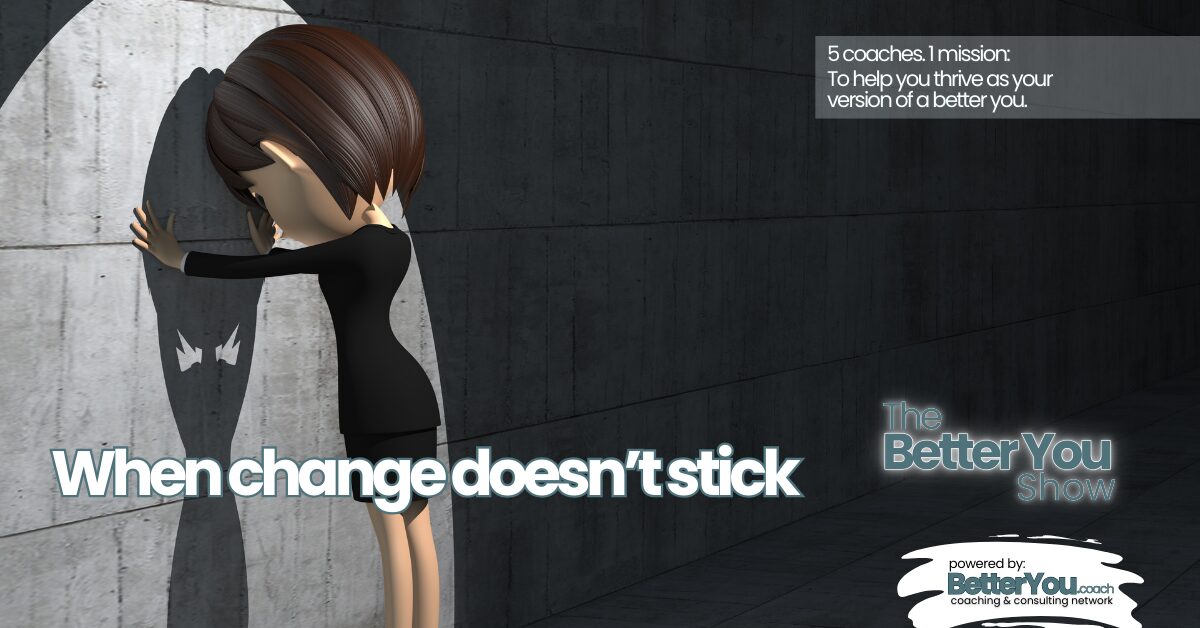
It’s a familiar moment.

You catch yourself doing something you said you wouldn’t do again. Reacting the same way. Avoiding the same thing. Falling back into an old habit or pattern you’ve already spent time understanding.
And almost immediately, something else shows up.
Shame.
Not loud shame. Quiet shame. The kind that says, “I should be past this by now,” or “I know better than this,” or “Why am I still here?”
Episode 13 of The Better You Show is about why this happens — and why it doesn’t mean anything is wrong with you.
In This Article
Awareness Is Already There
One of the most important things this episode makes clear is that most people are not unaware of their patterns.
They can name them.
They can see them coming.
They often recognize them while they’re happening.
Awareness is not missing.
In fact, awareness is often the first sign that change is already underway. It’s what allows you to notice the loop instead of being fully inside it.
The frustration begins when awareness doesn’t immediately lead to different behavior.
That’s usually when people assume they’ve failed.
What Happens After “I Know Better”
When awareness shows up, many people expect it to be the solution.
They assume that once they see the pattern clearly, they should be able to stop it. And when that doesn’t happen, the next move is almost always the same: try harder.
More discipline.
More rules.
More self-control.
More pressure.
This is where shame often deepens. Because now the story becomes, “If I know better and I’m still doing this, something must be wrong with me.”
But this is the point where the episode makes an important distinction.
Patterns don’t change through force.
Why Willpower Keeps Falling Short
Most repeating patterns are not bad habits you picked up randomly. They are learned responses.
They formed to help you cope, adapt, stay safe, or stay functional in a situation where something was required of you. At one point, that response worked. So your system kept it.
These patterns don’t live only in your thoughts. They live in your body and nervous system. They are tied to what feels familiar, predictable, and safe.
When you rely on willpower to change a pattern, you’re asking a system built on familiarity to move into something unknown without offering it a new experience of safety.
Pressure doesn’t interrupt patterns. It usually activates them.
That’s why trying harder often makes the pattern stronger, not weaker.
Nothing is wrong with you when this happens. The strategy just doesn’t match how patterns actually work.
Why Change Can Feel Risky — Even When You Want It
Even positive change can feel uncomfortable.
Familiar patterns, even painful ones, feel safer than unfamiliar choices. Safe doesn’t mean good. It means known.
This is why resistance often shows up quietly rather than dramatically. It can look like hesitation, fatigue, distraction, numbness, or a subtle pull back into what you already know.
These responses aren’t signs of failure.
They’re signals that something unfamiliar is being introduced and your system hasn’t learned yet that it’s safe.
When this is misunderstood, people often turn that discomfort inward and judge themselves for it.
The Limits of Doing This Alone

Many people listening to this episode are highly self-reliant.
They reflect. They analyze. They journal. They think things through and try again. That approach often developed because support wasn’t always available — and it worked, for a time.
But patterns can’t always interrupt themselves from the inside.
Support isn’t about fixing you or telling you what to do. It provides alternate and trained perspective, interruption, and maybe even regulation. It allows awareness to become something you experience in real time, not just something you understand intellectually.
This is one of the reasons insight can feel exhausting when it isn’t paired with the right kind of support.
Not All Patterns Come From the Same Place
Another key point in the episode is that patterns don’t all have the same root.
Some come from over-functioning or control.
Some come from emotional suppression or people-pleasing.
Some are shaped by burnout or long-term stress.
Others show up during major life transitions, when who you’ve been no longer fits who you’re becoming.
During these in-between moments, old patterns often pull the hardest — not because you’re regressing, but because identity hasn’t caught up yet.
This is why one-size-fits-all advice often falls flat. And why generic strategies can leave people feeling more discouraged instead of helped.
Change begins when the pattern is accurately named and the support matches what’s actually happening underneath.
A Different Question to Ask
The episode gently shifts the focus away from “What’s wrong with me?” to a more useful question.
Is the approach you’ve been using actually designed to help this pattern change?
Most people don’t reach out for support because they feel confident. They reach out because repeating the same thing starts to feel heavier than trying something different.
A conversation doesn’t mean commitment.
It doesn’t mean you’ve failed.
It simply creates space to see what’s actually happening — without shame — and to explore what kind of support would actually help.
If you keep finding yourself thinking, “I know better… so why is this still happening?” this might not be a sign to push harder.
It may be an invitation to approach change differently.
Disclaimer
The Better You Show and any content posted by BetterYou.coach, Doris Efford, and/or any agents of BetterYou.coach is presented solely for general informational, educational, and entertainment purposes. The use of information from the aforementioned sources or materials linked is at the user’s own risk. It is not intended as a substitute for the advice of any professional and/or individualized advice. Users should not disregard or delay in obtaining professional advice for their individual condition or situation.
For personalized coaching, contact BetterYou.coach
Leave a Reply