

By: Shelley McInroy, BetterYou.coach
A Quiet Confession
For years, I knew exactly what I was feeling.
My body told me.
- the tightness in my chest when something felt wrong,
- the flutter of excitement when something delighted me,
- the heaviness that settled in when grief arrived.
But when someone asked, “How are you feeling?”
I’d often say, “I’m fine” or “I’m tired.”
Not because I didn’t know — but because I didn’t have permission to say it out loud.

I grew up in a world where feelings weren’t really discussed.
You didn’t complain. You didn’t make a fuss. You kept going.
So, I learned to feel everything quietly, privately, alone — and to translate my inner world into acceptable, surface-level responses.
Even now, when I try to name what I’m feeling, I sometimes catch myself saying things like:
- “I feel like I’m failing.”
- “I feel like nobody cares.”
- “I feel like I’m not enough.”
But here’s what I’ve learned and I still need to remind myself:
those aren’t feelings.
Those are thoughts dressed up as feelings.
The actual emotions underneath might be:
- Shame (I feel like I’m failing)
- Loneliness or hurt (I feel like nobody cares)
- Inadequacy or fear (I feel like I’m not enough)
This distinction matters. When we mistake thoughts for feelings, we stay stuck in our heads — analyzing, judging, spiraling. But when we can name the actual emotion, something shifts. We drop into the body. We access the truth beneath the story.
I’ve spent years learning to translate my inner experience into real emotional language — not the language of judgment or comparison, but the language of what is actually happening inside me.
That’s what emotional literacy is: learning to speak the truth of your inner world, even when — especially when — you weren’t taught how.
In a world that moves faster than our nervous systems evolved to handle — where we’re expected to toggle between Zoom calls and school pickups, global crises and grocery lists — many of us are running on emotional fumes. We’ve learned to *manage* our schedules, but not to *name* what we’re carrying. And that unnamed weight? It doesn’t disappear. It accumulates.
In this Article
- This article is for you if:
- What Emotional Literacy Really Is
- Practice Prompt
- The Science of Naming Emotions
- Practice Prompt
- Emotions vs. Feelings: Understanding the Landscape
- The Emotions Wheel: Mapping Your Inner World
- When Naming Feels Hard
- Everyday Emotional Literacy Practices
- Integrating Literacy and Safety
- A Letter to You
- References
This article is for you if:
- You often say “I’m fine” when you’re not
- You feel things intensely but struggle to name them
- You grew up in a family where emotions weren’t discussed or named
- You’re a therapist, coach, or helper who wants to deepen your own emotional literacy
- You’re simply curious about the language of your inner world
What Emotional Literacy Really Is
Emotional literacy is the ability to recognize, understand, label, express, and regulate emotions — in ourselves and in others1. It’s not about controlling feelings or always staying calm. It’s about knowing what’s happening inside so we can respond with clarity instead of reactivity.
Without words for what we feel, emotions stay wild and wordless — overwhelming, confusing, sometimes frightening. But when we can name them, something shifts, moves, and can make more sense. The storm doesn’t disappear, but we regain our footing.
The Canadian Mental Health Association2 calls emotions “our internal stoplights” — signals that tell us when to pause, proceed, or protect ourselves. When we can read those signals, we make wiser choices about how to care for ourselves and connect with others.
Research shows that people with higher emotional literacy experience:
- Lower stress and anxiety3
- Clearer, more honest communication4
- Stronger, more resilient relationships
- Greater ability to ask for support when needed
Emotional literacy isn’t a luxury. It’s a foundational life skill — one many of us were never explicitly taught.
Practice Prompt
The Three-Word Check-In
Take a slow breath.
Let today replay softly behind your eyes.
Which three emotions visited you — not just “good” or “bad,” but something truer?
Write them down, or whisper them to yourself. Notice what shifts inside as you name them.
The Science of Naming Emotions
There’s something almost magical about naming a feeling — and neuroscience helps us understand why.
When we’re emotionally activated, the amygdala — the brain’s alarm system — lights up. It’s doing its job: alerting us to potential threat, loss, or significance. But when the amygdala is in charge, our thinking brain (the prefrontal cortex) goes offline. We react instead of respond.
Here’s where naming becomes powerful.
Research by Lieberman et al. 5 found that the simple act of labeling an emotion — saying “I’m feeling anxious” or “This is anger” actually reduces activity in the amygdala and activates regions of the brain linked with reasoning and reflection.
Naming what we feel helps calm the storm.
It doesn’t make the feeling disappear. But it creates a small, sacred space between sensation and action — a space where choice lives. That space is where emotional regulation begins.
Practice Prompt
The Whisper Test
When a strong feeling rises:
- Pause and take a slow, intentional breath.
- Whisper its name — anger, joy, fatigue, longing — softly to yourself.
- Notice the shift: your mind may feel a little clearer, your body a little lighter, a small space opening to choose your next step. Just naming it is enough. You don’t need to fix or change anything.
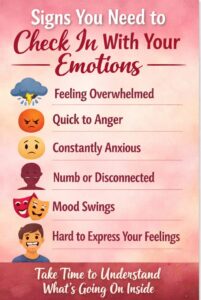
Emotions vs. Feelings: Understanding the Landscape
You might have heard these words used interchangeably — and in everyday conversation, that’s fine. But there’s a subtle distinction that can deepen our understanding.
Emotions are automatic physiological reactions — the body’s immediate response to a stimulus. They happen before we think about them.
Feelings are our conscious interpretations of those emotions — the stories we tell ourselves about what’s happening6.
For example:
- Your heart races (emotion: fear)
- You think, “I’m worried I’ll fail” (feeling: anxiety)
Understanding this distinction helps us see that emotions are information, not identity. We’re not “an anxious person” — we’re a person experiencing anxiety. That small shift creates room for self-compassion.
Basic Emotions and Their Messages
| Anger — Irritated, indignant, hot → A boundary’s been crossed | Sadness — Tender, disappointed, heavy → I’ve lost something that mattered | Surprise — Startled, curious, alert → Something unexpected has appeared |
| Fear — Uneasy, worried, tense → I sense danger or uncertainty | Disgust — Repelled, uneasy, withdrawn → Something feels unsafe or unwholesome | Joy — Content, inspired, light → Something meaningful is present |
When we trace emotions into their feeling-forms, we learn the body’s internal language — each word a signal, each signal a story.
The Emotions Wheel: Mapping Your Inner World
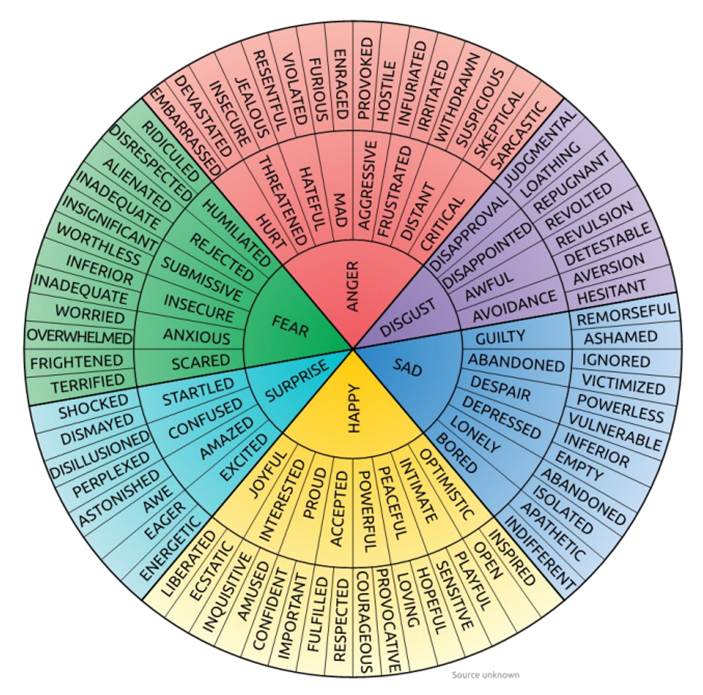
An emotions wheel is like a map of your inner landscape. It starts at the center with six core emotions and spirals outward into more nuanced feelings — from “sad” to “disappointed” to “let down” to “betrayed.”
I keep one where I can access it.
Sometimes it’s handy to have it, when I’m processing my own feelings, or when a client is processing theirs:
Oh. That’s not just frustration. That’s feeling ignored. And suddenly, the feeling makes more sense. It has a name. It has a place.
Activity – The Onion Layers: Notice and Name
A colleague once told me, “We’re all layered like onions — many stories, many feelings.” Each layer holds data, not drama. The wheel helps us peel back those layers with curiosity instead of judgment.
- Look at the outer ring of the emotion wheel. Choose a feeling that matches your current state.
- Pause and notice where it lives in your body. Is it tight, heavy, fluttery, or warm?
- Breathe into that space, noticing it without trying to change it.
- Ask quietly: “What is this feeling trying to show me?” Notice any subtler feelings that appear beneath the first one.
Give each feeling a word or short phrase — it can be literal (“anger”), sensory (“tight chest”), or metaphorical (“stormy sea”). Your goal is simply to recognise the sensation, acknowledge the feeling in your body.
You don’t need to fix anything. Noticing and naming is enough.
When Naming Feels Hard
Many of us grew up hearing messages like “Suck it up,” “Be strong,” or “Don’t cry.” Over time, these messages taught us that emotions were inconvenient, weak, or wrong. So we learned to push them down, ignore them, or numb them.
If emotional literacy feels foreign or difficult for you, please know: you’re not alone. You’re simply learning a language you may not have been taught.
Some people describe it as trying to solve a puzzle with missing pieces7. The feelings are there, but the words aren’t. Or the words are there, but they don’t quite fit.
That’s okay. This is a practice, not a performance.
The goal isn’t perfection. It’s curiosity — noticing what’s happening inside without judging it, learning to meet emotions with awareness instead of fear.
Practice Prompt — Notice and Name
- Think of a strong emotion you experienced this week.
- Pause and notice where you feel it in your body. Is it tight, heavy, fluttery, or warm?
- Name the feeling in a way that makes sense to you — a word, a short phrase, or even a metaphor.
- Ask quietly: “What is this feeling trying to tell me?”
- Simply notice any shift in your body or mind. You don’t need to fix or change anything.
Naming and noticing is the tool — it gives you a small space to understand and choose how to respond.
Everyday Emotional Literacy Practices
You don’t need hours of journaling or therapy to build emotional literacy. You can start small — with moments woven into the fabric of your day.
1. The One-Word Pause
- When a feeling rises, pause for a breath.
- Whisper one word that names it — frustration, sadness, hope, joy.
- Notice any small shift in your body or mind.
Quick, in-the-moment, and grounding.
2. Body Scan Check-In
- Take 30 seconds to notice where you feel tension, heat, or heaviness.
- Name the sensation: tight chest, fluttery stomach, heavy arms.
- Ask, “What is this trying to tell me?”
Brings awareness to physical cues before they overwhelm you.
3. Micro Reflection
- Ask yourself a gentle question at transitions: “Right now, what am I feeling?”
- Name it silently.
Works on the walk between meetings, waiting for coffee — tiny but cumulative.
4. Pause-and-Breathe
Choices
- When an emotion spikes, breathe in slowly, name the feeling, and think: “What can I do next?”
- No need to act immediately; just create space to choose.
Empowers you with curiosity and agency instead of avoidance.
5. Colour Your Feeling
- Notice a feeling that’s present right now — strong or subtle.
- Ask yourself: “If this feeling had a colour, what would it be?”
- Using your journal or a blank page, draw or colour in a shape, pattern, or space that reflects that feeling.
- Optional: Write a few words describing it — a body sensation, a metaphor, or a single word.
- Pause and notice: What happens as you give your feeling a visible form?
You don’t need to “make art.” This is a tool to see and name your emotions more clearly.
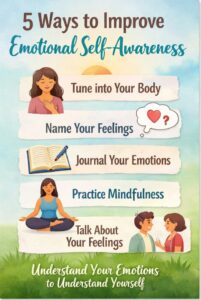
Integrating Literacy and Safety
Emotional literacy and embodied safety are twin roots of healing. One grounds the body; the other gives it words. When we can both feel and name, the nervous system relaxes, empathy deepens, and boundaries strengthen.
Remember from our earlier exploration of embodiment: when the body feels safe, it can be present. When we’re present, we can notice. When we notice, we can name. And when we name, we can choose.
This is the gentle, powerful spiral of emotional literacy.
A Letter to You
Dear Reader,
Learning to notice and name your feelings is like learning a new language — the language of your own mind and body. Some words will come easily; others may feel heavy, strange, or even unwelcome. That’s okay.
Every time you pause, breathe, and say “I feel…”, you are practicing curiosity. You’re giving yourself a small, quiet gift: the chance to understand yourself a little better.
I won’t pretend I always want to meet my feelings. I don’t.
Sometimes I still catch myself trying to skip over anger, fatigue, or worry. But I’m learning that even a tiny pause — a word, a breath, a whisper — can make a difference.
Some feelings carry messages we’ve long ignored. They may protect us, warn us, or point toward something we need. Sitting with them, even briefly, and naming them — that is an act of courage and self-respect.
You don’t need to fix anything, and you don’t need to judge yourself for what arises. Simply noticing is enough.
In your journal, or in quiet reflection, you might ask:
- Which feeling is hardest to name?
- Where do you feel it in your body?
- What might it be trying to show or protect you from?
There is no rush, no “correct” answer. This is a practice you carry with you, moment by moment. Some days it will feel easy; others, not so much.
And that’s part of learning your own language. Thank you for reading.
Warmly, and with the deepest gratitude,
Shelley 🌷

Author:
Shelley McInroy
Registered Therapeutic Counsellor & Certified Mental Wellness Coach
BetterYou.coach
References
- Brackett, M. A., Rivers, S. E., Shiffman, S., Lerner, N., & Salovey, P. (2006). Relating emotional abilities to social functioning: A comparison of self-report and performance measures of emotional intelligence. Journal of Personality and Social Psychology, 91(4), 780–795. ↩︎
- Canadian Mental Health Association. (2021). Understanding emotions and mental health. CMHA National. ↩︎
- Zeidner, M., & Matthews, G. (2018). Emotional intelligence in the workplace: A critical review. Frontiers in Psychology, 9, 2412. ↩︎
- Brackett, M. A., & Rivers, S. E. (2013). Transforming students’ lives with social and emotional learning. American Educator, 37(2), 6–11. ↩︎
- Lieberman, M. D., Eisenberger, N. I., Crockett, M. J., Tom, S. M., Pfeifer, J. H., & Way, B. M. (2007). Putting feelings into words: Affect labeling disrupts amygdala activity. Psychological Science, 18(5), 421–428. ↩︎
- Damasio, A. R. (1999). The feeling of what happens: Body and emotion in the making of consciousness. Harcourt Brace. ↩︎
- Mazefsky, C. A., & White, S. W. (2014). Emotion regulation: Concepts and practice in autism spectrum disorder. Child and Adolescent Psychiatric Clinics of North America, 23(1), 15–24. ↩︎
Leave a Reply