In This Article
- You Said Yes Again, Didn't You.
- What People-Pleasing Really Is (And What It Isn't)
- Where It Comes From: It Started Long Before You Could Spell 'Boundaries'
- The Codependency Connection: Why Other People's Feelings Feel Like Your Responsibility
- 8 Signs You May Be Running This Pattern
- The Real Cost of Staying Silent
- How to Begin: Small Steps That Actually Work
- What to Expect When You Start Changing
- The Midlife Turning Point: Why This Often Comes to a Head in Your 40s and 50s
- You Don't Have to Do This Alone
You Said Yes Again, Didn’t You.
You felt it the second the word left your mouth. That quiet, sinking feeling. Why did I say yes to that? And yet — when the moment came — you smiled, nodded, and said yes anyway.
You’ve probably told yourself it’s just who you are. That you’re a giving person. A helper. That it would be worse to say no.
But what if that’s not the whole story?
What if the pattern of constantly putting others first, managing their feelings before your own, and saying yes when every part of you wants to say no — isn’t a personality trait at all? What if it’s a survival response your nervous system learned a very long time ago?
That’s exactly what we’re exploring here — and it changes everything.
| People-pleasing isn’t a character flaw. It’s a coping strategy. And like any strategy, once you understand it, you can choose something different. |
Episode 26 of The Better You Show
This article brings together insight from our BetterYou coaches and the expertise of Nicky Yazbeck, a Licensed Clinical Social Worker (LCSW) with nearly 30 years of experience in trauma-informed healing, codependency, and self-abandonment. What follows isn’t a lecture on boundaries. It’s an honest conversation about what’s really going on — and what’s actually possible.
What People-Pleasing Really Is (And What It Isn’t)
Let’s get something clear first: there is nothing wrong with being a generous, caring, giving person. Kindness is a strength. Empathy is a gift. But there is a meaningful difference between choosing to help someone and feeling like you have no choice.
That’s the line that matters — and it’s one Nicky Yazbeck makes with precision in her clinical work. “People-pleasing, codependency, and masking,” she explains, “all belong in the same category. And at their core, they are a deep form of self-abandonment.”1
Self-abandonment. That’s a strong phrase. But think about it: when you agree to something that drains you, when you reshape your opinions to match the room, when you swallow what you actually need so someone else stays comfortable — whose needs are you abandoning? Yours.
The researchers and clinicians who study this pattern have given it a name: the fawn response. It’s the fourth trauma response, alongside fight, flight, and freeze. And it may be the least talked about — because from the outside, it doesn’t look like fear. It looks like kindness.
- Fight: push back against the threat
- Flight: remove yourself from the threat
- Freeze: become still, go numb
- Fawn: appease the threat — become agreeable, helpful, whatever they need — so the threat goes away
The fawn response is the most invisible trauma response because it looks like warmth. The person who never says no, who anticipates every need — their nervous system is not generous. It is trying to stay safe.2
That’s not weakness. That’s adaptation. And it may be one of the most intelligent things your nervous system ever did — at the time.
Where It Comes From: It Started Long Before You Could Spell ‘Boundaries’
The pattern almost always has roots in childhood. Not necessarily in dramatic trauma — though sometimes it does — but in the everyday conditions of growing up.
As Nicky explains: “We pick these patterns up very early. As kids, we want to be seen, heard, acknowledged. When we get positive feedback for being agreeable, helpful, easy — we do more of it.”
This is normal developmental learning. Children are wired for connection. Their survival — literally — depends on belonging to their caregivers. So when the environment signals that being ‘good’ (compliant, helpful, quiet, accommodating) gets you love, and being ‘difficult’ (honest, boundaried, needy) risks it — your nervous system learns the lesson quickly.
Our coach Shelley puts it this way: “From the very first moment we come into the world, our survival depends on whether we are wanted and belong. And our brains are geared for survival.”3
The messages don’t have to be spoken aloud. They come from watching the adults around you. From the family rule that says don’t rock the boat. From the teacher who praised the easy student and ignored the one with too many questions. From the social reward system that tells girls, in particular, that being liked depends on being accommodating.
Over time, these patterns become automatic. Research in trauma and nervous system regulation indicates that fawn responses can operate below conscious awareness — what began as a deliberate survival strategy becomes a reflexive pattern that activates whenever the nervous system detects signals resembling the original threat, even in objectively safe situations.4
That’s why ‘just say no more’ isn’t the answer. You’re not dealing with a bad habit. You’re dealing with a deeply wired nervous system response — and you can’t think your way out of a nervous system state.
| What works when you’re little sometimes doesn’t work when you become an adult. — Shelley McInroy, RTC |
The Codependency Connection: Why Other People’s Feelings Feel Like Your Responsibility
Here’s where it gets complicated — and where so many women get stuck.
When you’ve been people-pleasing for most of your life, you don’t just feel like you should help others. You feel responsible for how they feel. If someone is upset, it’s your job to fix it. If someone is disappointed, it’s because you didn’t do enough. If you say no and they react badly — that reaction feels like proof that you were wrong to say no at all.
This is codependency. And as Nicky clarifies: “That’s where all of this is born. We learn that we’re responsible for other people’s feelings. But by standing in your own truth — if that hurts somebody else, that is theirs.”
Easy to say. Genuinely hard to feel.
Because the guilt that comes with disappointing someone isn’t just discomfort. For many women with a fawn pattern, that guilt is indistinguishable from danger. The nervous system has wired boundary-setting as a threat — not a choice.
Codependency is really big. I think we all have it on some level, at least with somebody in our life. But it’s breaking that — being aware of it — that we’re not responsible for how other people feel. — Nicky Yazbeck, LCSW
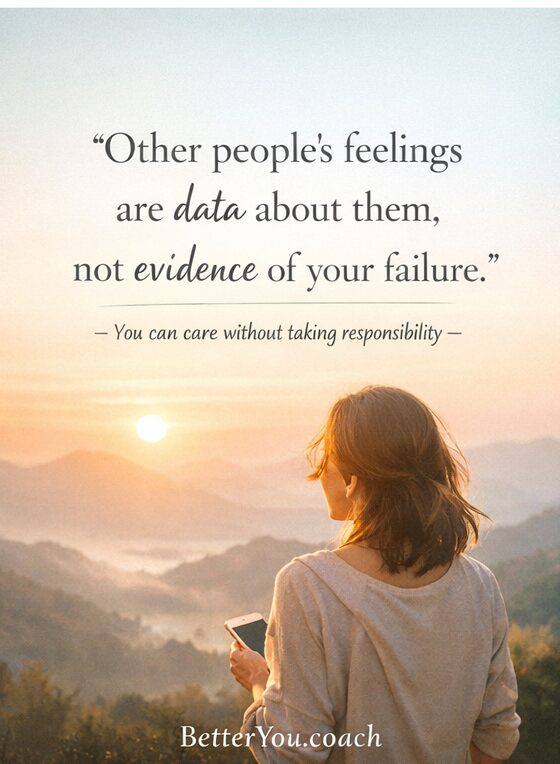
This distinction is life-changing: other people’s feelings are data about them, not evidence of your failure. You can care about how someone feels without being obligated to manage or fix it.
8 Signs You May Be Running This Pattern
Not everyone who people-pleases recognizes it as such. In fact, one of the most common things we hear from women is: “I just like helping people. What’s wrong with putting others first?”
Nothing — when it comes from genuine desire. Everything — when it comes from fear.
Here are some honest questions to sit with. They come directly from the clinical lens Nicky brings to this work:
- Are you saying yes to things you don’t actually want to do?
- Do you feel obligated — or even guilty — when you consider saying no?
- Do you scan the room to read how others are feeling before you decide how to act?
- When someone calls or walks in, does your body tighten — or does it light up?
- After spending time with certain people, are you drained, flat, or in a bad mood?
- Do you reshape your opinions depending on who you’re with?
- Are you avoiding a conversation because you don’t want to upset someone?
- Have you said yes, regretted it immediately, and then felt unable to change your mind?
If several of these landed, you’re not alone. This pattern shows up in friendships, marriages, workplaces — anywhere there’s a relationship and a perceived risk of disapproval.
As Nicky notes: “If any of this resonates, you are probably a people-pleaser. And it doesn’t mean something is wrong with you. It means your nervous system learned something — and it can learn something new.”
The Real Cost of Staying Silent
People-pleasing is often invisible to the people around you. You show up, you help, you smile, you manage. From the outside, you look like someone who has it together.
But here’s what’s happening underneath:
- The version of you others know isn’t really you. When you mask and mold yourself to what others need, they like a performance — not you. As Nicky puts it: “When we’re masking, we don’t actually know if they’re liking us for who we are. It’s not until we break down these barriers that we can be loved for exactly who we are.”
- Your nervous system is working overtime. Constantly scanning others’ moods, anticipating needs, managing reactions — that’s exhausting neurological labor. Over time, it depletes you.
- Your own needs become a mystery. When you spend years prioritizing outward attention, it becomes genuinely difficult to know what you want, what you like, what you need. You’ve been so focused outward that your inner voice went quiet.
- Resentment builds quietly. Even when you don’t express it, saying yes when you mean no creates an internal ledger. Over time, that ledger fills up — and it comes out sideways.
Our coach Joyce speaks to this from lived experience: “It hit me at 50. I’d been this way my whole life. And realizing what I actually wanted — it changed everything. There’s nothing wrong with pleasing people. But it’s when I want to, not when I’m expected to.”5
That shift — from obligation to choice — is everything. And it doesn’t happen by deciding to be different. It happens by doing the work to understand why you’ve been this way, and gently, gradually, building a new relationship with yourself.
How to Begin: Small Steps That Actually Work
The first question we always get: where do I start?
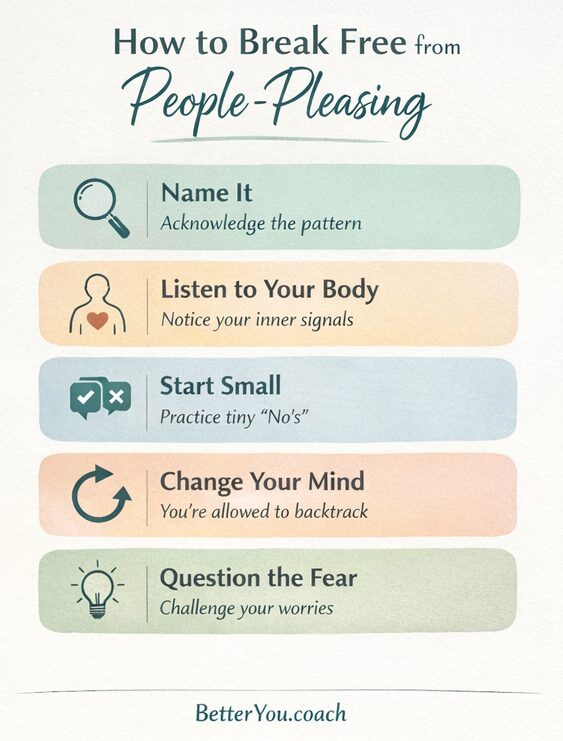
Here’s what our coaches and Nicky recommend — in a realistic, not overwhelming sequence.
Step 1: Name It
“The first step of any healing is acknowledgement,” Nicky says. “Just the fact that you can see it — that’s pulling something out of the shadow and into the light.”
You don’t need to have it all figured out. You just need to be willing to notice. Start watching for the moments when you say yes and your body contracts. When you agree and immediately feel the weight of it. That noticing is the beginning.
Step 2: Listen to Your Nervous System
Your body knows before your brain catches up. When someone calls, when a request comes in, before you answer — what does your body do? Does it lift, relax, feel easy? Or does it tighten, sink, brace?
Nicky frames this beautifully: “What is your nervous system telling you? When you spend time with this person, do you leave energized — or drained? That information is guidance, not weakness.”
Your nervous system is not dramatic. It’s data. Start treating it that way.
Step 3: Start Absurdly Small
Coach Tiffany’s advice is the most practical: “What’s one thing you can try saying no to that you’ve always said yes to? And then realize — oh. I actually can do this. And it’s okay.”6
Not the big conversation. Not the hard relationship. Start with the coffee order you actually want. The movie you choose instead of defaulting to someone else. The meeting you skip because you need a break. Build the evidence that saying no doesn’t end the world.
Step 4: Know That You’re Allowed to Change Your Mind
If you’ve been running automatic yes responses for 40 years, you won’t catch them all in real time at first. And that’s okay.
If you said yes, went home, and realized it should have been a no — you can call back. You can send a message. You are allowed to change your mind. Permission granted.
Step 5: Question the Catastrophe
Coach Sarah offers this reframe: “We often create in our minds that something worse is going to happen. But is it really? What if it doesn’t happen? Most of the time, we actually get positive feedback — or at the very least, the worst thing we imagined doesn’t occur.”7[13]
The fear that drives people-pleasing often predicts outcomes that never materialize. With each small step, you build evidence against the old story your nervous system is running.
What to Expect When You Start Changing
Here’s the part nobody tells you, and it matters.
When you begin showing up more authentically — when you start saying no, setting limits, expressing your actual needs — some people are going to react. Not all of them well.
“When you start setting boundaries and stepping into your authenticity, you will trigger other people,” Nicky says. “That’s just the reality of it. And when that happens, it’s a test: are you going back to the old way — or are you going to stand in your truth?”
People who are used to the old version of you will resist the new one. This isn’t because they’re terrible people. It’s because you changing the terms of the relationship feels threatening or confusing to them. Some will adjust. Some may not. And both of those outcomes give you information.
Coach Tiffany names the fear directly: “Part of the fear is that we’re going to lose friends, lose family. But you have to come back to yourself. What’s more important? Letting some people go at least for a time sometimes opens up space for others to come in.”
This is not about becoming cold, distant, or difficult. It’s about becoming real. And the people who can handle the real you? Those are the relationships worth building.
| When we stop masking, others don’t know who we really are. But it’s not until we break down these barriers that we can be loved for exactly who we are. — Nicky Yazbeck, LCSW |
The Midlife Turning Point: Why This Often Comes to a Head in Your 40s and 50s
There’s a reason this conversation tends to arrive with particular urgency for women in midlife. And it’s not a coincidence.
For many women, the 40s and 50s bring a collision: the roles that once gave their people-pleasing structure (raising children, building careers, holding families together) are shifting. And in the space that creates, something surfaces that’s been quietly asking to be heard for decades.
Coach Joyce is honest about this: “It hit me right around perimenopause. Having that breakdown — realizing where I wanted to be and what I wanted to be doing — it was huge for me. And it put me in a place where I was finally a much happier, much more present person.”
This is not a crisis. It’s a reckoning. And it’s also an invitation.
If you’re in this season and the quiet sense of exhaustion, resentment, or lost-ness is growing louder — it may be your nervous system finally feeling safe enough to be honest with you. That’s not a problem to fix. That’s a door opening.
You Don’t Have to Do This Alone
Understanding the pattern is the beginning. Shifting it — at the level of the nervous system, not just the mind — takes time, support, and usually a guide.
The work of unraveling people-pleasing is not about reading the right article (though we hope this one helped). It’s embodied work. It happens in relationship. It happens when you have a space where it’s safe to say the real thing, practice the new response, and build the evidence that being authentically you is survivable — and eventually, wonderful.
This is exactly the kind of work we do at BetterYou.coach. Our coaches specialize in the quiet, persistent exhaustion of women who’ve been taking care of everyone but themselves. We offer a free, no-obligation connection call — not a pitch, just a real conversation. You tell us where you are. We help you see what’s possible.
And if what you’re navigating has deeper clinical roots — trauma, complex attachment patterns, PTSD — the therapeutic work of specialists like Nicky Yazbeck is where that healing happens. nikkyyyoga.com integrates EMDR, somatic awareness, and trauma-informed therapy for exactly this kind of work.
| If something in this conversation stirred something in you — don’t let it just sit there. | |
| Book a Free Connection Call No pitch. No pressure. Just a real conversation — and more clarity than you came in with. → betteryou.coach/connect | Work With Nicky Yazbeck, LCSW Trauma-informed therapy, EMDR, somatic healing. Nearly 30 years of clinical experience. → nikkyyyoga.com |
About Our Expert Contributor
| Nicky Yazbeck, LCSW Licensed Clinical Social Worker | Trauma-Informed Therapist | Yoga Therapist Nicky Yazbeck is a Licensed Clinical Social Worker with nearly 30 years of experience whose work lives at the intersection of the mind, body, and the patterns we carry — often without knowing it. She specializes in trauma-informed healing, people-pleasing, self-abandonment, codependency, and emotional masking. Nicky integrates EMDR, somatic awareness, psychodynamic therapy, and insight-oriented talk therapy, working with the whole person, not just the surface. She is also the host of the Connected Community Podcast: Exploring Possibility, available on YouTube and all audio platforms. Connect with Nicky: nikkyyyoga.com |
About BetterYou.coach

BetterYou.coach is a heart-centred coaching network supporting women who are ready to find their way back to themselves — not back to who they were, but forward to who they are now. Our team of coaches brings expertise across life alignment, leadership, abundance, happiness, mindset, hypnotherapy, and therapeutic counseling. We believe every woman deserves a space where her real life — not the edited version — can be seen and supported.
- Coach Doris Efford (Host): Known as the Chaos Calmer, Doris is a Life Alignment Coach at BetterYou.coach, helping busy women create order, calm, and clarity in their lives——one phase-at-a-time.
- Counsellor Shelley McInroy: Shelley is a Registered Therapeutic Counsellor (RTC, ACCT) and Mental Wellness Coach at BetterYou.coach, offering a gentle, trauma-informed space to support women through anxiety, grief, burnout, and life transitions.
- Coach Tiffany Bayne: Tiffany (CLC, CHT, RSW) is a Mindset Coach and Certified Clinical Hypnotherapist at BetterYou.coach who helps women break through self-doubt and limiting belief blocks.
- Coach Joyce Erickson: Is known as the Happiness Igniter — a Happiness and Harmony Coach, Joyce helps women rediscover joy, rebuild presence, and bring lightness back into their everyday lives.
- Coach Sarah Rajkumar: is BetterYou.coach’s Transformational Leadership Coach. Sarah helps women step boldly into leadership and build businesses aligned with their purpose — through her signature Leadership with Love™ method.
References & Research
- Yazbeck, N. (LCSW). Quoted in The Better You Show, Episode 26: “People-Pleasing.” BetterYou.coach, 2025. nikkyyoga.com ↩︎
- Wright, A. (LMFT). “Fawning: The Trauma Response Disguised as People-Pleasing.” AnnieWright.com, April 2026. anniewright.com/fawning ↩︎
- McInroy, S. (RTC). Quoted in The Better You Show, Episode 26. BetterYou.coach, 2025. ↩︎
- Lovon Editorial. “What is Fawn Response: People-Pleasing as a Trauma Reaction.” Lovon.app, January 2026. lovon.app/blog/ptsd/what-is-fawn-response-people-pleasing-as-trauma-reaction ↩︎
- Erickson, J. Quoted in The Better You Show, Episode 26. BetterYou.coach, 2025. ↩︎
- Bayne, T. Quoted in The Better You Show, Episode 26. BetterYou.coach, 2025. ↩︎
- Rajkumar, S. Quoted in The Better You Show, Episode 26. BetterYou.coach, 2025. ↩︎
Watch The Better You Show on YouTube | Book your free connection call
Disclaimer
BetterYou.coach is a coaching network that matches people with their next right coach. We believe you’re not broken, you’re just human. And sometimes humans need support to thrive.
The Better You Show and any content posted by BetterYou.coach, Doris Efford, and/or any agents of BetterYou.coach is presented solely for general informational, educational, and entertainment purposes. The use of information from the aforementioned sources or materials linked is at the user’s own risk. It is not intended as a substitute for the advice of any professional and/or individualized advice. Users should not disregard or delay in obtaining professional advice for their individual condition or situation.
For personalized coaching, contact BetterYou.coach
Leave a Reply