
The holidays are supposed to feel warm and meaningful.
But for many people, they arrive carrying stress, expectations, and emotional weight instead.

You might feel excited and exhausted.
Grateful and overwhelmed.
Present on the outside, but stretched thin on the inside.
If that sounds familiar, there’s nothing wrong with you.
Holiday overwhelm isn’t a personal failure. It’s often a nervous-system response to pressure, old patterns, and too much happening at once. The good news is that overwhelm doesn’t need to be pushed through or powered over. It can be softened—gently and intentionally.
This article is a Holiday Overwhelm Toolkit: practical, human tools you can use before the holidays begin and during the moments when things feel hard. You don’t need to use all of them. Even one small shift can change how the season feels.
In This Article
Why the Holidays Feel So Overwhelming (Even When Things Are “Good”)
Holiday stress doesn’t come only from terrible home-life, long mental suffering, or even busy schedules or long to-do lists. It often comes from:
- Anticipating difficult conversations
- Re-entering old family dynamics
- Trying to meet unspoken expectations
- Wanting things to feel meaningful, but not knowing how
- Carrying grief, loneliness, or exhaustion beneath the surface
Your nervous system doesn’t know the difference between a real stressor and one you’re replaying in your mind. Worrying ahead of time can feel productive, but it actually keeps your body in a state of alert long before anything happens.
That’s why many people arrive at the holidays already depleted.
The tools below are designed to work with your nervous system—not against it.
Part 1: Tools to Establish Before the Holidays Begin
These tools help you prepare emotionally and mentally, so you’re not entering the season already on edge.
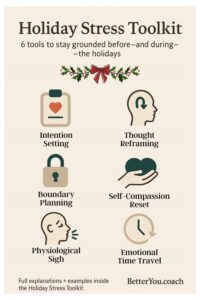
Tool 1: Set Emotional Intentions (Not Performance Goals)
When to use:
Before your calendar fills up or commitments are locked in.
How to use it:
Ask yourself three simple questions:
- How do I want to feel during the holidays?
- When have I felt that way before?
- What actually brings those feelings into my life?
Instead of focusing on what the holidays should look like, you focus on what matters most emotionally. Once you identify those feelings—peace, connection, ease, joy—you can align your plans accordingly.
Then, look at your calendar and ask:
- Does this support how I want to feel?
- What can be simplified or removed?
Why it works:
Your nervous system responds to clarity. When you know what you’re aiming for emotionally, decisions become easier and less reactive.
Benefits:
- Reduces overcommitting
- Creates permission to do things differently
- Anchors your season in meaning, not pressure
Tool 2: Reframe Stressful Thought Patterns
When to use:
In the weeks leading up to the holidays, especially if you notice repeating worries.
How to use it:
Notice common thoughts like:
- “This is always stressful.”
- “I have to get this right.”
- “I’m already behind.”
Instead of arguing with the thought, gently reframe it into something more supportive:
- “I can move through this with more ease than I think.”
- “I don’t need perfection to have meaning.”
- “I can take this one step at a time.”
Repeat the reframed thought while imagining yourself moving through a holiday moment calmly.
Why it works:
Your subconscious mind learns through repetition and emotion. When a new thought is paired with a felt sense of calm, your nervous system begins to respond differently in real situations.
Benefits:
- Interrupts stress spirals
- Builds emotional resilience
- Helps you feel more grounded before challenges arise
Tool 3: Pre-Plan Gentle Boundaries
When to use:
Before invitations, hosting duties, or obligations pile up.
How to use it:
Instead of saying yes immediately, practice phrases like:
- “Let me check my calendar and get back to you.”
- “I’ll see how I’m feeling closer to that date.”
- “Can I think about it?”
This gives you space to check in with your energy and decide from a grounded place.
You can also pre-plan support by identifying where you’ll ask for help:
- Sharing hosting tasks
- Asking others to bring something
- Letting go of doing everything yourself
Why it works:
Boundaries aren’t about saying no—they’re about giving yourself time and choice. That sense of agency reduces resentment and burnout.
Benefits:
- Preserves energy
- Reduces people-pleasing
- Makes the season more sustainable
Part 2: Tools to Use in the Moment When Things Feel Hard
These tools are for real-time support—when stress shows up at the dinner table, in conversations, or inside your body.
Tool 4: Reset Your Nervous System in Real Time
When to use:
When you feel overwhelmed, tense, overstimulated, or on edge.
How to use it:
Try a simple breathing technique called a physiological sigh:
- Inhale deeply through your nose
- Take a quick second inhale
- Exhale slowly through your mouth
Repeat two or three times.
You can do this anywhere—at the table, in the bathroom, outside for fresh air.
Why it works:
The double inhale re-expands the lungs, and the long exhale activates the vagus nerve, signaling safety to your body.
Benefits:
- Lowers stress quickly
- Releases physical tension
- Helps you respond instead of react
Tool 5: Normalize Emotional “Time Travel”
When to use:
When old emotions resurface and you feel like you’re “backsliding.”
How to use it:
If familiar feelings come up, remind yourself:
- “I’m not going backwards.”
- “This is an old response in a familiar environment.”
- “I have more choices now than I did before.”
Notice the feeling without judgment. You can silently say, “There’s that old feeling again,” and bring yourself back into the present.
Why it works:
Old environments can activate old neural pathways. Recognizing this prevents shame and allows for compassion.
Benefits:
- Reduces self-blame
- Increases emotional awareness
- Supports long-term healing
Tool 6: Practice Self-Compassion When Joy Feels Hard
When to use:
When the holidays don’t feel joyful and guilt creeps in try this practice from Dr. Kristen Neff.
How to use it:
Place a hand on your heart and say:
- “This is really hard right now.”
- “I’m not alone in feeling this way.”
- “May I be kind to myself in this moment.”
You don’t need to fix the feeling. Allowing it creates space for gentleness.
Why it works:
Self-compassion calms the nervous system and interrupts emotional spirals.
Benefits:
- Eases emotional pain
- Reduces guilt
- Builds inner safety
A Different Way to Move Through the Holidays
You don’t need to force joy.
You don’t need perfect traditions.
You don’t need to do the holidays the way you always have.
You’re allowed to choose calm.
You’re allowed to choose simplicity.
You’re allowed to choose support.
And if you find yourself wanting more guidance—someone to help you apply these tools to your life, your relationships, and your patterns—that support exists.
The holidays don’t have to be something you survive.
They can be something you move through with care.
And that’s enough.
This article is for educational and supportive purposes and is not a substitute for medical or mental health care. Always seek professional and individualized advice.
Leave a Reply