
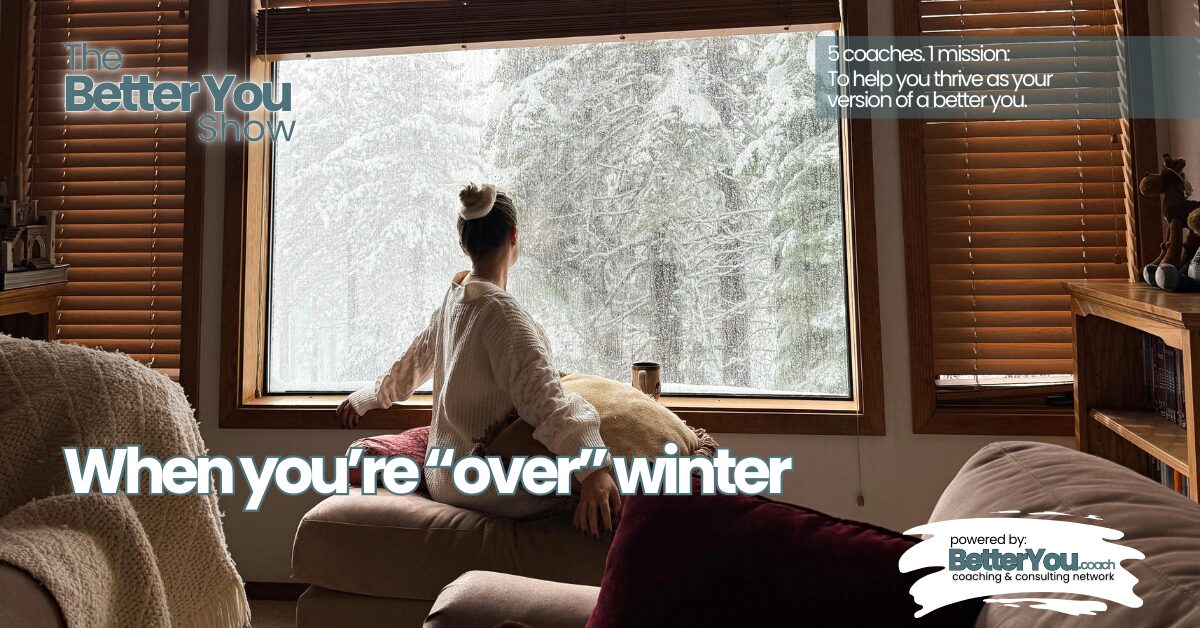
It’s February, and I’m ready to fight the thermostat.

Not because it’s broken—because I’ve been staring at the same four walls since November, and if I scroll through Netflix one more time just to pick the same show I’ve watched twice already, I might actually scream into a throw pillow.
If this sounds familiar, you might be experiencing cabin fever, and it’s hitting different this year.
In This Article
📺Watch: The Better You Show on Cabin Fever
Watch our full episode 17 where the coaches from BetterYou.coach discuss cabin fever and practical coping strategies (less than 20 minutes) or scroll below for key takeaways.
What Cabin Fever Actually Is (And Why It Feels Like This)
Cabin fever isn’t just “being sick of winter.” According to mental health professionals, it’s a real stress response that happens when we feel trapped by our environment. Your nervous system is literally in a rut.
Shelley McInroy, our registered therapeutic counsellor, puts it perfectly:
“It’s about lack of control. We all like our autonomy and being able to make choices, but when weather limits those choices, our whole system responds.”
The symptoms show up as:
- Restlessness and irritability (snapping at people you love)
- Low motivation (everything feels like “too much work”)
- Sleep disruption (either sleeping too much or struggling to sleep)
- Comfort-seeking behaviors that don’t actually comfort (hello, third bag of popcorn)
- That specific feeling of being “over it”
Sound about right?
The Vitamin D Deficiency Nobody Talks About Enough
Here’s what’s actually happening in your body: Reduced sunlight exposure decreases serotonin production and disrupts your circadian rhythm. This isn’t weakness—it’s biology.
Between November and March, people in northern climates can experience more than 50% less natural light exposure. Your brain notices. Your mood notices. Your energy levels definitely notice.
But before you resign yourself to hibernation until May, let’s talk about what actually helps.
The “Easy Solutions” That Make It Worse
Let’s be honest about the things we reach for that feel good in the moment but compound the problem:
Endless scrolling.
You know the routine—pick up your phone “just for a second,” look up 45 minutes later (or more), and feel somehow more restless than before.
Netflix marathons.
Watching TV isn’t bad. But when it becomes your only activity, and you’re not even enjoying what you’re watching, you’re not relaxing—you’re numbing.
Comfort eating without the comfort.
That third bowl of popcorn, the late-night snacks, the “I deserve this” mentality that leaves you feeling sluggish and frustrated with yourself.
Staying inside because getting ready is too much work.
The socks, the boots, the coat, the scarf, the hat, the gloves, finding where you put your phone, realizing you need tissues, getting it all on… and then needing to pee.
(If you laughed, you get it.)
None of these are wrong. They become problems when they’re the only things we’re doing.
Need help getting out of the winter blues?
Take our quick quiz to find your next right coach.
What Mental Health Experts Say Actually Helps
1. Interrupt the Loop
Your nervous system gets stuck in patterns. Your mind follows. Breaking that loop doesn’t require a complete life overhaul—it requires 60 seconds.
Been sitting at your desk? Try this right now: Stand up. Shake your arms for a moment. Stomp your feet. Do jumping jacks if you’re feeling ambitious. It sounds silly, but this physical interruption signals your nervous system that something has shifted.
Joyce Erickson, our happiness coach, shares: “Even just meeting a friend for lunch when it’s freezing outside—that change in routine, that connection—it reminds you there’s life beyond these walls.”
2. Change Something Small About Your Routine
Not your whole life. Just something.
Take a different route on your walk. Have eggs instead of oatmeal. Read in a different chair. Call a friend you haven’t talked to in a while.
The goal isn’t to find the “perfect” new routine—it’s to create variety where monotony has settled in.

3. Seek Out Sensory Experiences
Your brain is craving stimulation it normally gets from being outside. You can’t recreate summer, but you can offer your senses something new.
Ideas that actually work:
- Walk through the plant section at the grocery store (seriously—the green, the different air quality, the smells)
- Sit in the viewing area at a pool (moist air, bright lights, warmth—all the sensory triggers of vacation)
- Visit a botanical garden or greenhouse
- Go to a coffee shop you’ve never tried
- Light a candle with a scent that reminds you of summer
Coach Doris discovered this accidentally: “I started sitting in the pool viewing area while my kids had lessons. The moist air, the heat, the bright lights—it gave me all the sensory triggers of a vacation in 30 minutes.”
4. Get Outside Even When You Don’t Want To
The barrier isn’t the cold—it’s all the preparation the cold requires.
Solution? Create a reward worth the effort.
Tiffany, a hypnotherapist and mindset coach, says: “I get my coffee. That’s my motivating factor while I’m putting on all that gear. I have the end goal in mind, and it works.”
You’re not trying to love winter. You’re trying to get 15 minutes of daylight and a little dopamine from accomplishing something.
5. Move Your Body (But Not How You Think)
Forget the treadmill if you hate the treadmill. Stop forcing yourself to do exercises you’ve convinced yourself you “should” do.
What would actually feel good? Dancing in your kitchen? YouTube yoga? A 10-minute walk around the block?
Movement isn’t about burning calories right now—it’s about shifting energy that’s gotten stagnant.
6. Connect With Humans In Real Life
Text a friend: “I need to see a human face that isn’t on a screen.”
Meet for coffee. Meet for lunch. Meet for a 20-minute walk. Meet for literally anything.
One of the coaches shared how a friend texted her: “I need to see my friends!” They met halfway between their homes for lunch that turned into three and a half hours of conversation.
That’s what your nervous system needs—real connection, real laughter, real hugs.
7. Work or Read Somewhere Different
Same activity, different location.
If you work from home, try a different room. Go to the library. Set up at a coffee shop for an hour.
If you don’t work from home, apply this to your personal life. Read in a different room. Eat breakfast at the table instead of the couch.
Your brain associates locations with activities. Changing the location tricks your brain into experiencing the familiar as fresh.

8. Address the Vitamin D Situation
Talk to your doctor about vitamin D supplementation. Most people in northern climates are deficient during winter months, and it directly impacts mood, energy, and sleep.
A light therapy lamp (10,000 lux) used for 20-30 minutes in the morning can also help regulate your circadian rhythm.
This isn’t alternative medicine—this is addressing a biological need.
9. Plan Something to Look Forward To
A trip is excellent, but it doesn’t have to be that big or immediate. Even if it’s small. Even if it’s more than week from now.
Book a dinner reservation. Plan a day trip. Schedule a video call with someone you miss. Buy tickets to something.
Hope is a practical emotion. Give yourself something concrete to anticipate and have fun preparing for.
10. Get Support That Goes Deeper Than Tips
Here’s the truth nobody posts on Instagram: Sometimes cabin fever is actually a symptom of something bigger.
If you notice these patterns repeating every winter, or if you’re feeling stuck beyond just seasonal blues, that’s information. Your system is telling you something needs attention.
The Thing Therapists Want You to Know
Shelley McInroy, who works with clients experiencing seasonal depression and life transitions, says: “We can give you all the tips in the world, but if your nervous system is stuck in a loop, if there are deeper patterns at play, you need someone to help you interrupt that at the root level.”
That’s the difference between coping strategies and actual change.
Coping strategies help you survive the season. Therapy and coaching help you understand why certain seasons (literal or metaphorical) knock you down harder than others—and build resilience that lasts beyond February.
What If You Need More Than Tips?
If you’re reading this and thinking “I’ve tried these things, and I still feel stuck,” or “This happens every year and I’m tired of white-knuckling through winter,” that’s exactly what coaches and therapists help with.
Not generic advice. Not one-size-fits-all solutions.
Personalized support that addresses:
- Why YOUR nervous system gets stuck in specific loops
- Your unique triggers and patterns
- Sustainable strategies that fit your actual life
- The deeper work that creates lasting change
Different types of support work for different people:
- Life coaching for alignment and forward momentum
- Happiness coaching for rewiring your relationship with joy
- Leadership coaching for the leader in you
- Hypnotherapy and mindset work for subconscious pattern interruption
- Therapeutic counseling for processing deeper emotional blocks
The right fit depends on where you are and what you actually need.
You’re Not Broken, You’re Just Human in February
If this winter has felt harder than usual, if you’re snapping at people you love, if you can’t seem to find motivation for anything, if the couch has become both comfort and prison—you’re not failing at life.
You’re experiencing a completely normal response to environmental stressors, biological shifts, and the monotony of limited options.
The fact that you’re reading this means you’re ready for something to shift.
Start with one thing. Not ten. One.
Pick the tip that made you think “I could actually do that.” Do it tomorrow. See what changes.
And if you realize you need support that goes deeper than tips, that’s not weakness—that’s wisdom.
Ready to explore what personalized support could look like for you? Take our 3-minute matching quiz to find the type of coach or therapist whose expertise aligns with what you actually need right now. Because the right support isn’t one-size-fits-all—it’s exactly-fits-you.
BetterYou.coach is a coaching network that matches people with their next right coach. We believe you’re not broken, you’re just human. And sometimes humans need support to thrive.
The Better You Show and any content posted by BetterYou.coach, Doris Efford, and/or any agents of BetterYou.coach is presented solely for general informational, educational, and entertainment purposes. The use of information from the aforementioned sources or materials linked is at the user’s own risk. It is not intended as a substitute for the advice of any professional and/or individualized advice. Users should not disregard or delay in obtaining professional advice for their individual condition or situation.
For personalized coaching, contact BetterYou.coach
Leave a Reply