How the sneaky side of fear keeps women stuck — and what to do about it
Have you ever talked yourself out of something important?
You wanted to make a change. Maybe it was a career move. A relationship. A dream you’d been sitting on for years.
And then the voice showed up.
Not a panicked, dramatic voice. A calm one. A sensible one.
It said things like: “We have bills to pay.” “Now isn’t the right time.” “Think about everyone else.” “Be realistic.”
So you listened. You called it wisdom. You called it responsibility. And you stayed put.
What if that voice wasn’t wisdom at all? What if it was fear — wearing a very convincing disguise?
| “Fear is kind of sneaky sometimes. It can show up as being reasonable, or responsible, or caring, or loyal.” — Counsellor Shelley McInroy |
This article walks you through what fear really sounds like when it isn’t loud or dramatic — and what it quietly steals from women over time. You’ll also find practical tools to tell the difference between fear and your own inner knowing, so you can start making decisions that are actually yours.
In This Article

- 📺Watch: The Better You Show on Ways Fear is Disguised
- What Fear Actually Sounds Like (When It Isn't Obvious)
- Why High-Achieving Women Are Especially Good at Hiding Fear
- What Fear Quietly Steals from Women Over Time
- Intuition vs. Fear: How to Actually Tell the Difference
- Scarcity Thinking vs. Abundance Thinking: The Mindset Behind the Fear
- Practical Tools to Reconnect With Your Intuition
- The Dickens Protocol: A Simple Exercise for Big Decisions
- "Giving Up" Is Not the Easy Option
- Can You Do This Work Alone?
- What the First Step Actually Looks Like
- You Noticed Something Today. That Matters.
📺Watch: The Better You Show on Ways Fear is Disguised
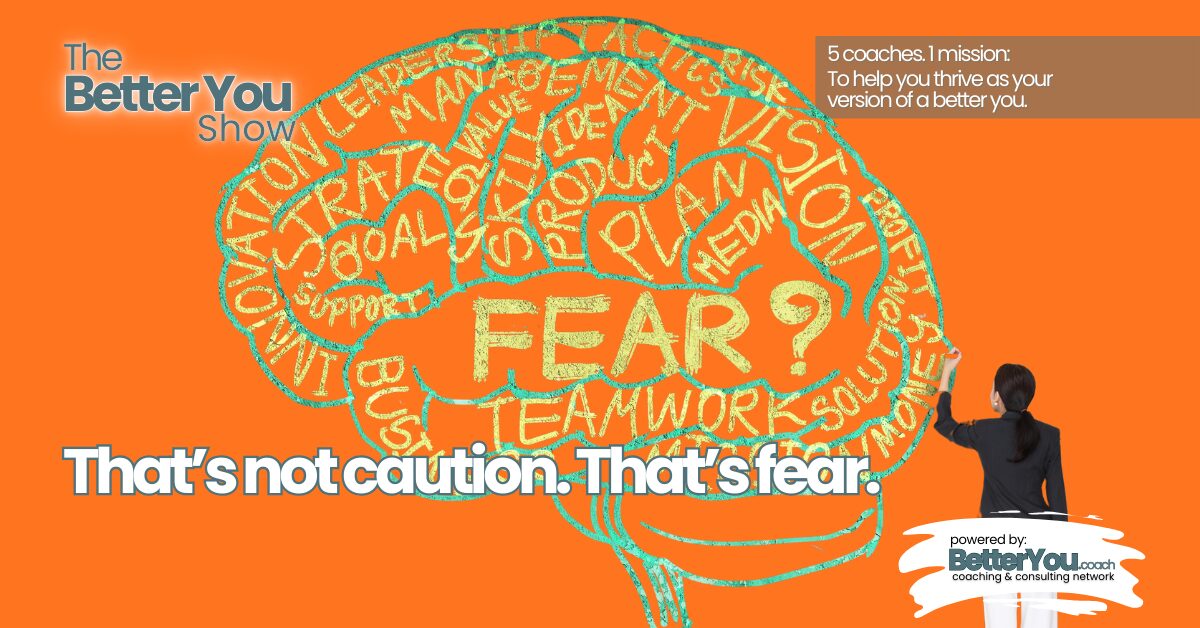
Watch our full episode 18 where the coaches from BetterYou.coach discuss the sneaky ways fear shows up as responsibility, loyalty, and practicality — and what it quietly steals from women over time.
What Fear Actually Sounds Like (When It Isn’t Obvious)
Most people think of fear as a racing heart. A clear danger. An obvious threat. But the fear that holds women back most often isn’t like that at all. It whispers. It sounds helpful. It sounds like you.
Fear Disguised as Being Sensible
“I want to change careers, but we have bills. The kids need stability. I’m getting older. It’s just not the right time.”
Sound familiar? This is one of fear’s favourite costumes. Being sensible feels virtuous. Responsible. Mature. But here’s the thing: there is never a perfect time to take a leap. If you’re waiting for the stars to align before you choose yourself, you may be waiting for a very long time.
Being sensible keeps you safe. But it can also keep you stuck. And the longer you stay stuck, the harder it gets to hear your own voice underneath all that practicality.1
Fear Disguised as Loyalty
“I can’t do that — what about my family? My team? The people who count on me?”
Loyalty is a beautiful quality. But real loyalty — the kind that lasts — has to include your own well-being. When you pour endlessly into everyone else and never refill your own cup, you don’t just run low. You run empty. And an empty cup can’t give anything to anyone.2
Fear of disappointing others, fear of being seen as selfish, fear of changing a dynamic that other people rely on — these are real fears. But they wear the face of loyalty, which makes them much harder to question.
Fear Disguised as Being Practical
“What about money? What if it doesn’t work? What will people think?”
Women in particular are often raised to be practical — to put the needs of the household, the family, the team above their own desires. Over time, this conditioning can quietly become a way of not choosing yourself. Not because you don’t want to. But because fear has made “being practical” feel like the most responsible option available.
As Counsellor Shelley puts it: we wear these things as a costume. As an excuse. Not to choose ourselves.
| Fear Can Sound Like: “Now isn’t the right time.” “I need to be realistic.” “What will people think?” “I can’t let people down.” “What if it doesn’t work?” “I should be grateful for what I have.” |
Why High-Achieving Women Are Especially Good at Hiding Fear
If you’re someone who shows up, gets things done, and is known for being dependable — this section is for you.
High-achieving women are often the best at masking fear. The higher you climb, the more pressure there is to look like you have it together. So fear doesn’t show up as hesitation or paralysis. It shows up as over-functioning. People-pleasing. Taking the safe choice. Making decisions based on what will stabilize everyone else — and then trying to fit your own needs in around the edges.
Leadership coach Sarah works with women in exactly this position. She explains that when you’re always trying to be the go-to person, the one others look up to, fear often disguises itself as imposter syndrome — that quiet background voice asking whether you’re really qualified to make bold decisions.
The antidote? You don’t need permission from anyone. Making bold, courageous decisions — even uncomfortable ones — actually rewires your brain over time. The more you practice it, the less fear has to say.3
| “You don’t need to take permission from anyone. Make that choice, even if it feels uncomfortable. Be courageous.” — Coach Sarah |
What Fear Quietly Steals from Women Over Time
This is the part nobody really wants to sit with. Because it requires looking back, not just forward.
When fear stays in the driver’s seat — dressed up as responsibility, loyalty, and practicality — it doesn’t just slow you down in the moment. It steals things. Sometimes for years.
- It steals a bolder, more authentic version of your life.
- It steals your ability to trust your own instincts.
- It steals your dreams — slowly, quietly, until you can’t quite remember what you were hoping for.
- It steals your sense of self.
Coach Joyce wanted to be a life coach at 18 years old. People told her she was crazy. Life coaching wasn’t a real career. So she listened to them instead of herself. Years later, she knows her intuition was right. And while she’s doing the work she was always meant to do now, she still wishes she’d listened sooner.
Counsellor Shelley describes it this way: when we don’t make choices for ourselves, we kind of forget ourselves along the way. We stop trusting ourselves. We stop listening to ourselves. And if someone suddenly stopped the movie of your life and asked, “So what is it that you need?” — a lot of women genuinely wouldn’t know. The dreams haven’t been visited in so long, they’ve gone quiet.
| “We stop trusting ourselves, we stop listening to ourselves. If someone stopped the life movie and said ‘What do you need?’ — lots of times, we don’t know.” — Counsellor Shelley McInroy |
Coach Sarah names the cost plainly: emptiness. Not being fulfilled. Questioning whether you were ever driven by your real purpose at all — or just by what was expected of you. And that haunts people, she says. Badly.4

The good news is this: awareness is where it turns around. The moment you can see fear for what it is — not wisdom, not responsibility, just fear — is the moment it starts to lose its grip.
Intuition vs. Fear: How to Actually Tell the Difference
This is the question that matters most — because they can feel confusingly similar in the body. Both create discomfort. Both can make you hesitate. So how do you know which one you’re listening to?
Fear Is Future-Focused
Fear lives in the “what ifs.” What if I fail? What if people judge me? What if it all falls apart? It is catastrophic in nature — it takes you to worst-case scenarios and parks you there. It doesn’t allow you to rest easy in a decision. It keeps things spinning.5
Intuition Is Present-Focused
Intuition says: this is what I need now. It is quieter than fear. Less urgent. It doesn’t spiral. And even when it’s pointing you toward something uncomfortable, there is a quality of knowing to it — a steadiness underneath the discomfort.
Coach Tiffany describes it as checking your body: do I feel peace and clarity about this, or do I feel heavy and frantic? The physical sensation is often your first honest answer, before your brain starts rationalizing.
Counsellor Shelley learned this the hard way — twice. Both times she was offered a job and her gut said don’t take it. Both times, circumstances (needing work, feeling desperate) overrode that inner knowing. Both times, it was a disaster. She doesn’t do that anymore. Her intuition, she says, has gotten quite loud.
| 🚨 Fear Sounds Like… | ✅ Intuition Sounds Like… |
| Future-focused — “what if” | Present-focused — “what I need now” |
| Catastrophic thinking | Steady, even if uncomfortable |
| Creates urgency and spiraling | Creates a sense of knowing |
| Feels anxious and unsettled | Feels calm beneath the discomfort |
| Driven by worst-case scenarios | Aligned with your values |
| Pushes you to decide fast | Allows you to slow down |
Scarcity Thinking vs. Abundance Thinking: The Mindset Behind the Fear
Fear and scarcity are close cousins. When you’re making decisions from fear, you’re almost always making them from a scarcity mindset — there isn’t enough time, money, opportunity, or support. And where your focus goes, your energy flows. If you’re constantly focused on what’s missing, you create more of the same experience.6
Abundance thinking looks completely different. It doesn’t mean ignoring obstacles. It means approaching them with: I will learn from this. I will find a way. Even if this doesn’t work, it moves me forward.
The shift from scarcity to abundance isn’t about pretending everything is fine. It’s about being open — because if you are not open, you will never receive what’s waiting for you.
Coach Sarah explains that scarcity often comes from how we grew up — our environment, the messages we received about safety and risk and worthiness. These shaped our identity in ways we don’t always recognize. We operate from these old programs automatically, without realizing that we have a choice to rewrite them.
| “If you are not open, you will never receive.” — Coach Sarah |
Practical Tools to Reconnect With Your Intuition
If you’ve spent years pushing your instincts down, listening to everyone else first, and defaulting to logic and practicality — your intuition may feel very quiet right now. That’s okay. It hasn’t left. It just needs some space. Here are the tools our coaches use and recommend:
1. Slow Down Before You Decide
If you’re in a state of urgency, anxiety, or overwhelm, you are at high risk of making decisions that aren’t actually best for you. Counsellor Shelley‘s first recommendation is simply: slow down. Breathe. Go for a walk. Find your inner safety before you make any choice. When we feel rushed, we make decisions to escape the discomfort — not decisions aligned with who we are.
2. Sleep On It
Coach Joyce uses a simple rule: if she doesn’t feel a clear yes right away, she sleeps on it. If it still feels uncertain in the morning, that’s a no. If her intuition is saying go, she says she’ll feel it clearly — like a kick. If you need more information before you can feel that clarity, give yourself time to get it. Uncertainty alone is often a no for now.
3. Check Your Body
Coach Tiffany‘s go-to is body-based awareness. When she imagines herself making a decision, she checks: do I feel peace and clarity, or do I feel heavy and frantic? Your nervous system knows things your analytical mind is still catching up to. Before you read the pros and cons list, check in physically.7
4. Meditate With the Question
Coach Tiffany also recommends sitting in meditation with a question held gently in mind — not trying to solve it, just allowing. Then journaling immediately after to see what surfaces. This practice separates your intuitive knowing from the mental noise of fear and obligation.
5. Ask: Does This Align With My Values?
Both Coach Tiffany and Counsellor Shelley return to this question as a way to distinguish healthy caution from fear-based stalling. Healthy caution serves your values and your goals. Fear prevents you from living an authentic life. When you feel resistance, ask: is this resistance protecting something important — or is it protecting me from something I actually need?
| Quick Gut-Check Before Any Big Decision: Is this a clear yes — or am I forcing it? Am I deciding from urgency, or from clarity? Does this align with what I actually value? Am I avoiding this because it’s wrong — or because it’s scary? If I imagine myself five years from now having done this, how do I feel? |
The Dickens Protocol: A Simple Exercise for Big Decisions
Tony Robbins uses a process called the Dickens Protocol, named after Charles Dickens’s A Christmas Carol — the idea of visiting past, present, and future to understand the real cost of your choices.8
Coach Tiffany references it as one of her favourite tools. The process works like this:
- Imagine yourself two to five years from now if you make no change. Really sit in that future. What does it look, feel, and sound like? How does your body respond?
- Now imagine yourself two to five years from now if you do make the change. What’s possible? How do you feel?
- Notice the emotional information in your body — not just the logical information in your head. The contrast often makes the right direction much clearer.
It can feel uncomfortable. That’s the point. Fear keeps things abstract so they feel manageable. This exercise makes them concrete so you can make an honest, informed choice.
“Giving Up” Is Not the Easy Option
Here is something most people don’t say out loud: giving up is hard too.

When your intuition is pulling you toward something and you override it — telling yourself it’s not practical, it’s too risky, no one supports it — you don’t actually settle into peace. You settle into something that sits in your body as a quiet, persistent rejection of yourself.
As Coach Sarah explains: when you say “I give up,” you’re not actually accepting the situation. You’re just trying to accept it. And there’s a difference. That difference shows up as restlessness, low-grade unhappiness, and the lingering question of “what if.”
| “Which hard is better for you? Choose that.” — Coach Sarah |
The truth is: moving forward is hard. Staying put is hard. But only one of them moves you toward the life you actually want.
So instead of asking “what if it goes wrong?” — try asking: what if it works? What if there’s a whole direction, a whole version of your life, waiting on the other side of this one uncomfortable choice?
Can You Do This Work Alone?
Yes. Some people do. But it is significantly harder without support — and here’s why.
When you’ve spent years operating from fear-based patterns, those patterns feel like reality. They feel like you. Getting outside of them on your own is like trying to read a book that you’re inside of. It’s very hard to see the full picture from in there.
A coach, counsellor, or trusted support person who meets you where you are — without an agenda for what you choose — can do several things that are very hard to do alone:
- Help you hear your own intuition more clearly by reflecting it back to you without judgment
- Validate what you’re experiencing so you feel less alone in it
- Collapse the timeline — what might take ten to fifteen years of trial and error alone can happen much faster with the right guidance
- Hold the space for you to be honest about what you actually want, not just what seems responsible
As Counsellor Shelley notes: our families love us, but they often steer us in directions that work for them without realizing it. You need someone with no stake in your outcome — someone who can be a sounding board for what’s true for you.
And as Coach Joyce discovered through her own breakdown: talking to someone who has lived experience or professional training in what you’re going through isn’t weakness. It’s the fastest, clearest path through.9
What the First Step Actually Looks Like
The very first step isn’t taking a leap. It isn’t quitting your job or ending a relationship or making any big external move.
The first step is simply recognizing: I don’t fit my situation right now. Something needs to change. I’m resisting.

That recognition — just noticing that you’re in discomfort, that the fear triggers keep firing, that you’re going through the motions of a life that doesn’t feel quite right — is where everything starts. That’s the signal that a transition is needed, even before you know what that transition looks like.
From there, the next step is reaching out. Not to have all the answers — but to stop being alone with the question.
| “Outgrowing a season is not a betrayal. It is an evolution.” — Coach Sarah |
You Noticed Something Today. That Matters.
If any part of this article landed for you — if you recognized yourself in the sensible voice, the loyal one, the practical one — that recognition alone is meaningful. It’s the beginning of something.
You cannot un-see what you’ve just seen. And that’s actually a good thing.
Fear doesn’t go away overnight. But when you can name it — when you can say “that’s not wisdom, that’s fear in a costume” — it loses some of its power over you. Every time you name it, it loses a little more.
You matter. Your dreams matter. Your needs are not less important than everyone else’s. And choosing yourself — really choosing yourself, maybe for the first time in a long time — is not selfish. It is necessary.
| Ready to Find Out What’s Really Blocking You? Take our free quiz and get matched with the right support for your next step. BetterYou.coach Quiz |
About the BetterYou Coaches
This article draws on a real conversation between five coaches at BetterYou.coach — a coaching network dedicated to helping women thrive as their version of a better self.
- Coach Doris (Host): Known as the Chaos Calmer, Coach Doris Efford is a Life Alignment Coach at BetterYou.coach, helping busy women create order, calm, and clarity in their lives——one phase-at-a-time.
- Counsellor Shelley: Shelley McInroy is a Registered Therapeutic Counsellor (RTC, ACCT) and Mental Wellness Coach at BetterYou.coach, offering a gentle, trauma-informed space to support women through anxiety, grief, burnout, and life transitions.
- Coach Tiffany: Tiffany Bayne (CLC, CHT, RSW) is a Mindset Coach and Certified Clinical Hypnotherapist at BetterYou.coach who helps women break through self-doubt and limiting belief blocks.
- Coach Joyce: Is known as the Happiness Igniter — a Happiness and Harmony Coach, Joyce Erickson helps women rediscover joy, rebuild presence, and bring lightness back into their everyday lives.
- Coach Sarah: is BetterYou.coach’s Transformational Leadership Coach. Sarah Rajkumar helps women step boldly into leadership and build businesses aligned with their purpose — through her signature Leadership with Love™ method.
Sources & Further Reading
The following sources informed or support the concepts discussed in this article:
- Brown, B. (2010). The Gifts of Imperfection. Hazelden Publishing. Brown’s research on vulnerability and shame documents how “playing it safe” is one of the most common ways fear operates invisibly in adult decision-making. ↩︎
- Neff, K. (2011). Self-Compassion: The Proven Power of Being Kind to Yourself. William Morrow. Neff’s research on self-compassion demonstrates that prioritizing one’s own wellbeing is not selfish but necessary for sustainable care of others ↩︎
- Dweck, C. (2006). Mindset: The New Psychology of Success. Random House. Dweck’s foundational work on growth mindset supports the idea that bold decision-making rewires neural pathways over time, reducing fear responses. ↩︎
- van der Kolk, B. (2014). The Body Keeps the Score. Viking. While focused on trauma, van der Kolk’s research on the body’s role in storing unprocessed emotional experiences is relevant to understanding the physical cost of long-term suppression of authentic self-expression. ↩︎
- LeDoux, J. (1996). The Emotional Brain. Simon & Schuster. LeDoux’s neuroscience research on the amygdala explains why fear is inherently future-focused and threat-anticipatory by design. ↩︎
- Robbins, T. (1991). Awaken the Giant Within. Free Press. The concept of “where focus goes, energy flows” is attributed to Tony Robbins and reflects principles from cognitive behavioural psychology on attentional bias. ↩︎
- Porges, S. (2011). The Polyvagal Theory. W.W. Norton. Porges’s research on the autonomic nervous system supports somatic (body-based) approaches to emotional decision-making, explaining why physical sensation is a reliable source of information prior to cognitive processing. ↩︎
- Robbins, T. Date With Destiny Seminar. The Dickens Protocol is a neuro-linguistic programming exercise used by Tony Robbins in his signature event. Named after Charles Dickens’s A Christmas Carol, it uses temporal contrast (past/present/future visualization) to clarify the cost of staying in current patterns. ↩︎
- Grant, A.M. (2012). The Impact of Life Coaching on Goal Attainment, Metacognition and Mental Health. Social Behavior and Personality: An International Journal. Research indicates professional coaching significantly accelerates goal achievement and self-awareness development compared to self-directed growth alone. ↩︎
Disclaimer
BetterYou.coach is a coaching network that matches people with their next right coach. We believe you’re not broken, you’re just human. And sometimes humans need support to thrive.
The Better You Show and any content posted by BetterYou.coach, Doris Efford, and/or any agents of BetterYou.coach is presented solely for general informational, educational, and entertainment purposes. The use of information from the aforementioned sources or materials linked is at the user’s own risk. It is not intended as a substitute for the advice of any professional and/or individualized advice. Users should not disregard or delay in obtaining professional advice for their individual condition or situation.
For personalized coaching, contact BetterYou.coach
Leave a Reply