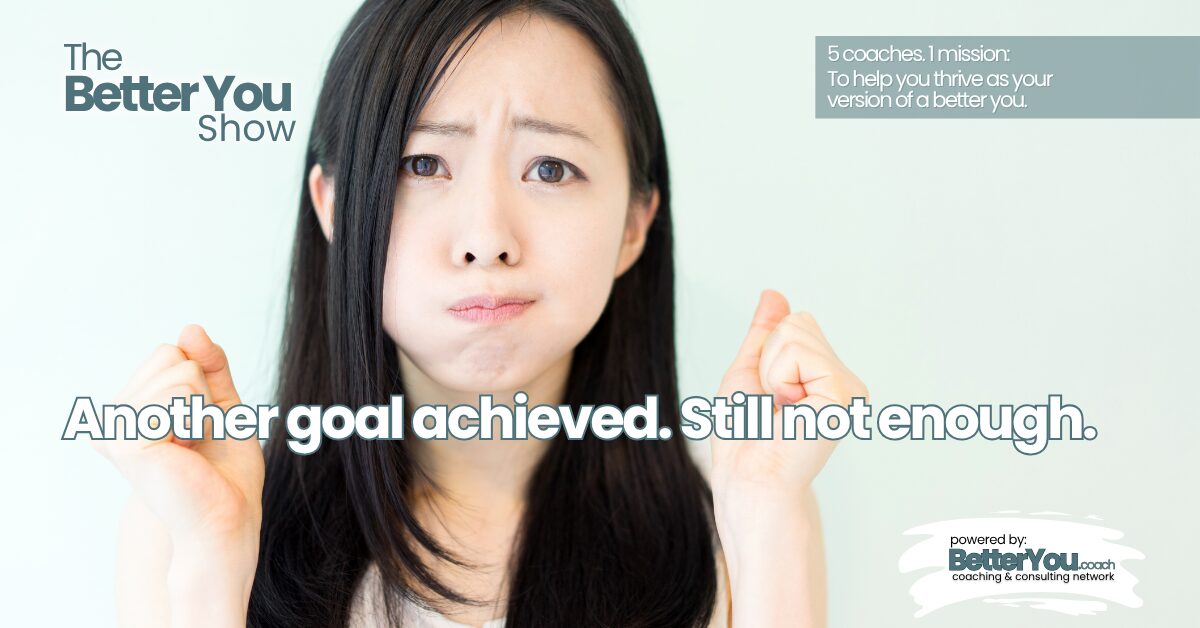
Everyone around you sees a woman who has it together.
The results are real. The recognition is real. The calendar is full and the achievements are documented and from where anyone else is standing, you are doing exactly what you’re supposed to be doing.
And you are exhausted in a way you have never once said out loud.
You hit the goal. You take a breath. Maybe a day. And then, almost before the feeling of accomplishment has a chance to settle, something in you is already scanning for the next one. Not because you’re ambitious. Not because you’re greedy. Because stopping, even for a moment, feels vaguely dangerous in a way you’ve never been able to explain.
So you don’t stop. You deliver. You perform. You add another credential, another result, another thing you can point to as proof. Proof of what, exactly, you’re not entirely sure. But the drive is relentless, and from the outside, it looks like success. And that’s the part nobody talks about. What happens when success is the survival strategy and you can’t tell the difference anymore?
In This Article
- What the Achievement Loop Is Actually Doing
- Episode 31 of The Better You Show
- What Makes This So Hard to See
- What's Actually Driving the Achievement Loop
- What It Takes to Break Free Without Burning Everything Down
- What would it feel like to achieve something and actually feel it?
- Meet the Coaches
- The Research Behind This Article
- Disclaimer
What the Achievement Loop Is Actually Doing
Achievement isn’t the problem.
The problem is what’s driving it and what it’s costing you. There’s a version of high-achieving that comes from genuine passion, curiosity, and desire. And then there’s a version that comes from somewhere older and more urgent than that1. A version that learned, somewhere along the way, that your value had to be earned. That being enough required constant proof. That if you stopped performing, something would be taken from you2. Approval, safety, belonging, love.
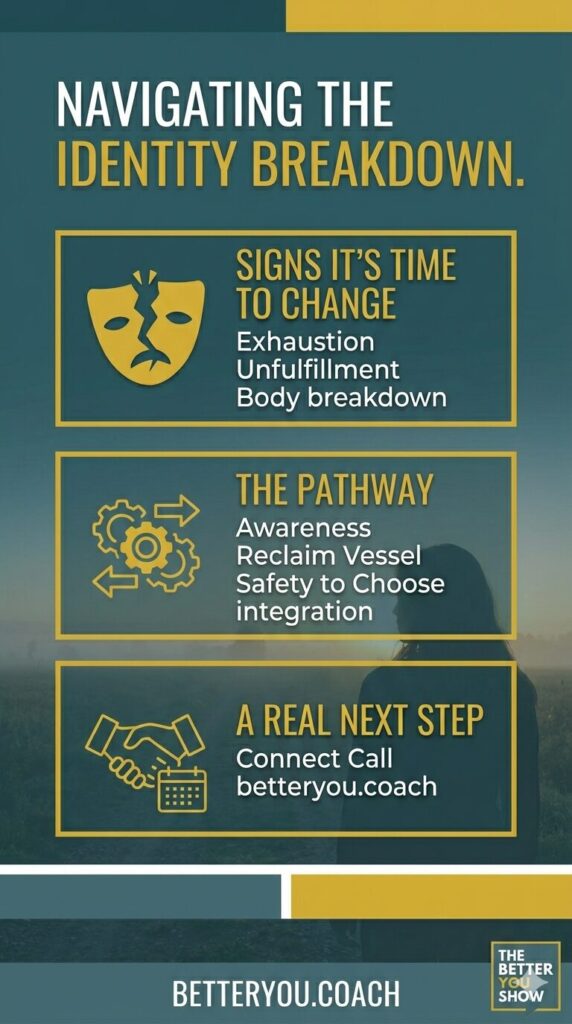
That identity had a purpose. At some point, it genuinely protected you. The problem, Dr. Antiqua explains, is that “the version that saved her life at one point, eventually that version is going to cost her. It’s going to cost her happiness. It’s going to cost her peace. It’s going to cost her own identity because she’s trying to be everything for everybody else.”
Dr. Lisha Antiqua, who holds a PhD in transpersonal psychology and has spent over 20 years studying what happens to identity when survival becomes a strategy, calls this the survival identity. It’s the version of you that was built, not chosen, in response to what life required. “She became the good girl,” Dr. Antiqua describes. “She became the achiever. She became the caretaker. The woman who could handle everything and needs nothing.”
The achievement loop isn’t ambition. It’s armor3. And it’s running on a program that was written a long time ago.
Episode 31 of The Better You Show
This article draws on insight from the BetterYou.coach team and the expertise of Dr. Lisha Antiqua, a PhD in transpersonal psychology with over 20 years of research at the intersection of trauma, identity, and survival. What you’ll hear isn’t a conversation about mindset or motivation. It’s an honest look at why the version of you that held everything together is the same version that’s keeping you stuck. And what it actually takes to find your way back to who you really are.
Dr. Lisha Antiqua joins Doris, Shelley, Joyce, and Tiffany on The Better You Show, Episode 31 — watch the full conversation.
What Makes This So Hard to See
Here’s the cruelest part of the survival identity.
It works. From the outside, it looks exactly like the life you’re supposed to want. The results are real. The recognition is real. And the people around you (your family, your colleagues, anyone watching) have no idea that the woman delivering all of it is running on empty.
Shelley, Registered Therapeutic Counsellor at BetterYou.coach, describes what’s happening on the inside while the outside looks polished: “You appear like you’re functioning. You look like you’re doing great and you hold onto that.” But underneath, she says, there’s a normalizing of something that should never become normal, “that internal collapse that happens, that feeling of not being fulfilled, the flatness that comes, that lack of joy.”
And the applause makes it worse. When society cheers, when your family cheers, when every external signal tells you this is working… Why would you question it? Shelley puts the bind plainly: even when your insides are imploding, you go on. “You normalize that internal collapse. You go, oh no, this is okay. I’ll get through this.”
You’re not getting through it. You’re getting used to it.
The survival identity is particularly deceptive because it doesn’t feel like a coping mechanism. It feels like you. It feels like the most natural thing in the world to push harder when something feels off, to add another goal when the last one didn’t fill the gap, to perform your way through a season that’s asking you to stop. Because that’s what you’ve always done. Because it’s worked. Because it looks like strength.
But there’s a difference between strength and armor. And the armor has been on so long you’ve forgotten it isn’t skin.
A note for the woman who’s reading this and thinking: “This isn’t me. I actually love what I do.”
That might be true. And it might also be true that the love you feel for your work has become inseparable from the fear of what happens if you step back from it.
Both things can be real at the same time. The question isn’t whether you’re passionate.
The question is whether you’re allowed to rest.
What’s Actually Driving the Achievement Loop
The drive to prove yourself through achievement doesn’t come from ambition. It comes from an internal system that learned that approval equals safety.
Dr. Antiqua explains the mechanics: when “have to be’s” and “should be’s” become the operating system, and when pleasing everyone around you becomes the price of feeling safe, you don’t just lose rest. You lose choice. “It steals away choice4,” she says. “And it steals away safety. And internally, in the nervous system level, it creates a war against yourself.”
This is not a mindset problem. This is a nervous system problem.
Shelley draws the line clearly: “Our nervous systems and our neural pathways don’t necessarily gravitate toward change. We’ve been wired. And when we’re starting to be aware that something isn’t quite right, our brains keep following that same pathway5.”
That’s why insight alone doesn’t break the loop. You can know exactly why you do this. You can name it, journal it, talk about it in therapy, and still find yourself saying yes when you meant no, adding a new project when you’re already depleted, measuring your worth against your output before you’ve finished your coffee.
The knowing is not the same as the changing. And the reason isn’t weakness. It’s neuroscience. Your nervous system is doing exactly what it was trained to do.
Why You Can See the Pattern and Still Can’t Stop
There’s a poem Shelley references in conversations about this moment.
You walk down a street. There’s a hole in the sidewalk. You fall in. You climb out and keep going. The next time you walk down that street, you see the hole and you fall in anyway. And again. And again. Until, eventually, you walk around it. And eventually, you take a different street entirely.6
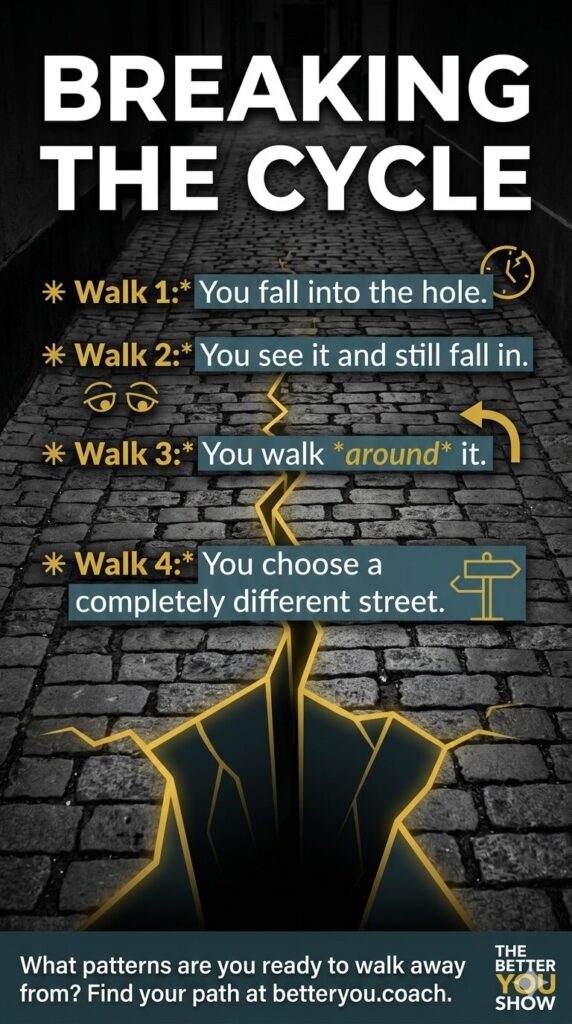
Most women caught in the achievement loop are at the early stages of this poem. They can see the hole. They know they’re going to fall in. They fall in anyway. And then they spend a significant amount of energy feeling ashamed of themselves for it . Which burns up exactly the fuel they’d need to find a different street.
Tiffany, Hypnotherapist and Mindset Coach at BetterYou.coach, reframes this moment deliberately: “It’s the way of making your unconscious conscious so that you can actually heal. If you can look at it that way, it’s kind of a good thing. Your nervous system is in a place where it can bring this stuff up now. This is your opportunity to work through this, whereas before you couldn’t.”
The pattern surfacing again isn’t evidence that you’re broken. It’s evidence that the work is available to you now in a way it wasn’t before.
Doris, Life Balance Coach and Founder of BetterYou.coach, works with clients at exactly this juncture; the moment between seeing the hole and taking a different street. “They recognize that they’re self-sabotaging, they finally feel safe enough to explore options, but they just can’t see the way around it. So we make a plan to get around it.” Not a reframe. Not a new affirmation. A plan. Concrete, specific, built around the actual shape of the pattern so the next time she’s standing at the edge of it, she has something more than willpower to work with.
What It Takes to Break Free Without Burning Everything Down
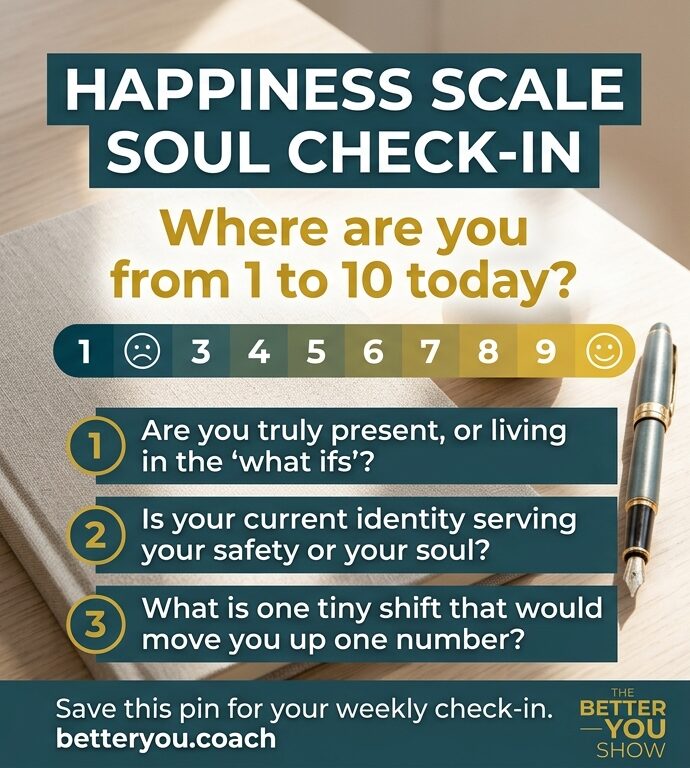
The fear underneath the achievement loop is almost always the same: if I stop proving myself, I’ll lose everything.
The relationship. The respect. The sense of self. The belief that she’s worthwhile at all.
So women don’t stop. They push. And sometimes they push until their body stops them7. Things like autoimmune disease, burnout, a breakdown that finally forces the question. Dr. Antiqua sees this too: “She sees her body breaking down in autoimmune diseases, but she still can’t say no. She still shows up.”
The BetterYou.coach approach doesn’t ask you to stop cold. It doesn’t ask you to blow up the life you’ve built. It starts with a single, foundational question: is it safe to choose?
Not safe in the logical sense. Safe in the felt sense. Because you can intellectually know that saying no won’t actually destroy your marriage, your career, or your sense of worth and still find your nervous system treating it like a life-or-death threat. Dr. Antiqua says that getting them into that pattern of, “It is safe to choose.” Then “Choose who you are.” That’s the beginning of a different road.
Joyce, Happiness and Harmony Coach at BetterYou.coach, left a 10-year career she genuinely loved because she recognized that what looked like a good life wasn’t the life that was actually hers. “Going back to do something that I wanted to do when I was 18 years old at 50,” she says. It required holding her ground when the people around her questioned it. It required believing that her sense of aliveness was worth more than the approval her survival identity had been chasing. “If mom and wife is happy, everything’s good.”
That’s not a small thing. That’s the whole thing.
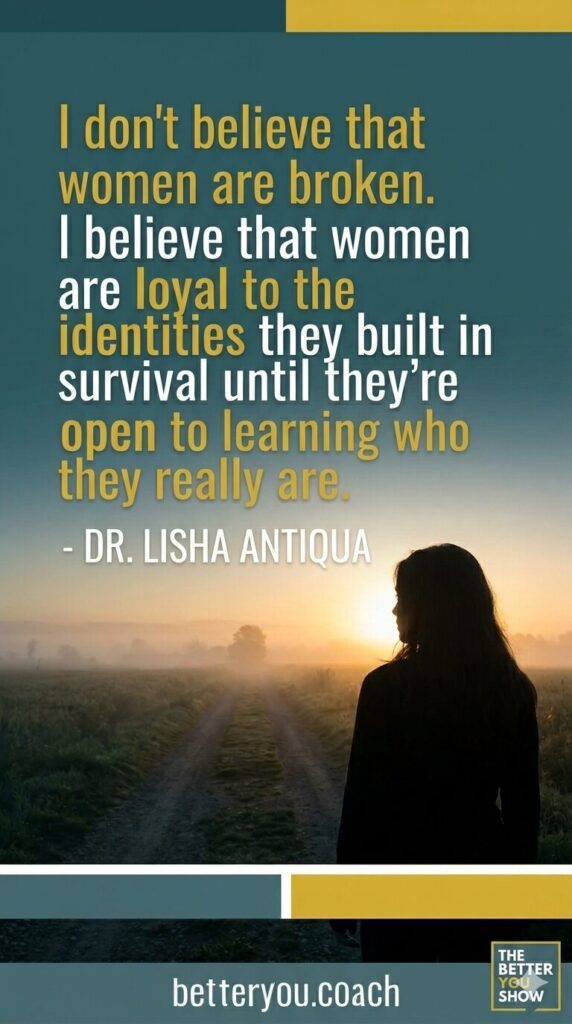
“I don’t believe that women are broken. I believe that women are loyal to the identities they built in survival until they’re open to learning who they really are.”
— Dr. Lisha Antiqua, PhD
The survival identity didn’t make you weak. It made you functional in conditions that required it. But you’re not in those conditions anymore. And the version of you that held everything together, she deserves a rest. She deserves to be thanked. And then she deserves to be gently, carefully, safely retired.
Because underneath her, there’s a woman who has opinions about what she actually wants. Who has desires she’s been told were impractical or impossible or too much. Who is allowed to choose. Not because she’s finally proven herself worthy, but because she always was.
That woman isn’t lost. She’s just been waiting for it to be safe enough to come forward.
What would it feel like to achieve something and actually feel it?
Not the momentary relief of checking a box. Not the quiet dread of the next goal already forming. Actually feel it. The satisfaction, the pride, the sense that this was worth it.
If you can’t remember the last time that happened, that’s worth paying attention to.
At BetterYou.coach, we work with women who are performing at a high level and quietly running on empty. We don’t ask you to stop achieving. We help you figure out what you’re actually working toward and whether the life you’re building is one you’ll want to live in.
No pressure. No commitment. Just a conversation that’s entirely yours.
Meet the Coaches
Dr. Lisha Antiqua
Dr. Lisha Antiqua holds a PhD in transpersonal psychology and has spent over 20 years working at the intersection of trauma, identity, and healing. She created the Amazing YOU Method — a trauma-informed framework for reconnecting to yourself and rebuilding identity from the inside out — and founded Your Own University, where coaches, therapists, and educators come to heal while they learn to lead. She is a best-selling author, sought-after speaker, and a leading voice on survival identity and what it costs us when we stay loyal to it past the point it serves us.
Dr. Antiqua offers a free quiz at Your Own University to help you identify where you are in your own identity and healing process.
Take the quiz 👉https://yourownuniversity.com/soul-architype-uc
🌐 yourownuniversity.com 🌐 lishaantiqua.com
BetterYou.coach Team
Doris — Life Balance Coach | The Chaos Calmer | Founder Doris works with women who are holding everything together on the outside while quietly losing themselves on the inside. She helps clients move from overwhelmed and stuck to clear, grounded, and back in the driver’s seat of their own lives.
Book a free VIP Coaching Assessment
Shelley — Registered Therapeutic Counsellor Shelley brings a clinical lens to the patterns that keep women stuck — helping clients understand not just what they’re doing, but why their nervous systems keep leading them there. She specializes in the kind of deep, roots-level work that makes lasting change possible.
Book a free Discovery Call
Joyce — Happiness and Harmony Coach | The Happiness Igniter Joyce helps women find their way back to joy — not the performed kind, but the kind that comes from the inside out. She knows what it’s like to rebuild at 50, and she brings that lived understanding into every session.
Book a free Happiness Assessment
Tiffany — Hypnotherapist and Mindset Coach Tiffany works where the conscious mind can’t reach — using hypnotherapy to access and shift the unconscious patterns that awareness alone can’t move. She helps clients release the old identity and make room for the one that’s been waiting.
Book a free Breakthrough Session
The Research Behind This Article
- Wright, A. (2026). Achievement as Survival: When Success Is a Trauma Response. Annie Wright, LMFT. Explains how compulsive achievement can develop as a trauma‑rooted survival strategy rather than genuine ambition. ↩︎
- International Trauma Professionals Association. (2025). Trauma‑Adapted Identity: The Ecophenotype Model of Survival‑Based Personality. Psychotraumatology. Describes how chronic developmental trauma shapes identity into adaptive personas (e.g., achiever, appeaser) built to maintain safety. ↩︎
- Wright, A. (2026). Achievement as Survival: When Success Is a Trauma Response. Annie Wright, LMFT. Identifies compulsive achievement as a protective adaptation, psychological armor, rather than ambition. ↩︎
- International Trauma Professionals Association. (2025). Trauma‑Adapted Identity: The Ecophenotype Model of Survival‑Based Personality. Psychotraumatology. Discusses how chronic trauma restructures identity around survival imperatives, reducing perceived choice and autonomy. ↩︎
- Lusk, J. (2025). The Neurobiology of Trauma. Psychology Today. Explains how trauma conditions the nervous system to default to familiar survival pathways, even when they no longer serve the individual. ↩︎
- Nelson, P. (1993). There’s a Hole in My Sidewalk: The Romance of Self‑Discovery. Beyond Words Publishing. One of the book’s central poems, Autobiography in Five Short Chapters, illustrates how repeated patterns eventually give way to conscious change. ↩︎
- Wright, A. (2026). Achievement as Survival: When Success Is a Trauma Response. Annie Wright, LMFT. Notes the physiological toll of chronic survival‑driven achievement, including burnout and health breakdowns. ↩︎
Disclaimer
BetterYou.coach is a coaching network that matches people with their next right coach. We believe you’re not broken, you’re just human. And sometimes humans need support to thrive.
The Better You Show and any content posted by BetterYou.coach, Doris Efford, and/or any agents of BetterYou.coach is presented solely for general informational, educational, and entertainment purposes. The use of information from the aforementioned sources or materials linked is at the user’s own risk and there is potential for monetary compensation at no extra cost to the user. It is not intended as a substitute for the advice of any professional and/or individualized advice. Users should not disregard or delay in obtaining professional advice for their individual condition or situation.
For personalized coaching, contact BetterYou.coach.
Leave a Reply