

There’s a version of this story you might already know. The absent father. The difficult relationship. The obvious wound that needed healing. But this article isn’t about that story. It’s about the quieter one.
It’s about the woman who would tell you — honestly — that she had a good dad. Maybe even a great one. And yet something hasn’t quite worked. She finds herself pulling away just when things get close. She over-explains, over-functions, over-apologizes, and can’t quite name why. She’s built a capable, full life, and still, underneath it all, there’s a low hum that won’t settle.
If any part of that lands — even a small part — stay with this.

What you’re about to read draws on the lived experience of our coaching team at BetterYou.coach and a deep conversation with Kevin McNee, men’s connection coach and founder of Men For More, who has spent years working with both men and women around what he calls the wounded masculine and the father wound. Kevin’s perspective is unique: a man who has done this work on himself, and who has sat with women as they did it too. His insight shapes much of what follows, and we are grateful for it.
This is not a therapy manual. It’s not an accusation toward your father. It’s an invitation to look at something that might be running quietly in the background of your relationships, your confidence, and your sense of what you deserve — and to understand it, finally, in a way that sets something free.
In This Article
- Episode 27 of The Better You Show
- What Is the Father Wound… Really?
- The Signs You Might Not Have Connected to Your Father
- Why Dads Didn't Always Know Better And Why That Matters for Your Healing
- Get more conversations like this one, straight to your inbox
- How the Father Wound Shows Up in Your Relationships Right Now
- Where the Healing Actually Starts
- What About When Your Father Was Truly Harmful?
- The Relationship Piece: When Your Wound Is Affecting Your Partnership
- A Note on Acceptance and What It Actually Means
- You Can't Change What Happened. You Can Change What It Means.
- About Kevin McNee
- References & Further Reading
- About the BetterYou Coaches
- Disclaimer
Episode 27 of The Better You Show
This article was inspired by a real conversation had on The Better You Show. Want to hear it straight from our coaches? Watch the full episode here then keep reading for the expansion.
What Is the Father Wound… Really?
The term sounds clinical, even dramatic. But the reality of it is often softer and far more ordinary than the name implies.
The father wound isn’t necessarily about what your father did to you. It’s often about what was missing.
Emotional presence. The sense that he truly saw you. The experience of being safe with a man — safe enough to be imperfect, to take up space, to be fully, openly yourself. When that felt absent — even in a home full of love and good intention — the child’s mind does what children’s minds do: it fills in the gap with a story.
And the story is almost always some version of: “I must not be enough. I must not be safe. I cannot trust.”
That story doesn’t stay contained to your relationship with your father. It travels with you. Into the way you relate to partners, to authority, to your own ambitions. Into whether you believe you’re allowed to ask for what you need. Into how quickly you apologize, how rarely you rest, how hard it is to let anyone truly in.
| “You might have had the best father — and there are still ways that you were hurt by his actions or inaction. That shaped how you grew up, how you show up in relationships, what you’re afraid of, where you hold yourself back. All of that can be true at the same time.” — Kevin McNee, Men For More |
This is important to name clearly: recognizing the father wound is not about blame. It is not about deciding your father was a bad man or that your childhood was a catastrophe. It is about understanding what happened — with compassion for everyone involved — so that you can stop carrying it forward.
The Signs You Might Not Have Connected to Your Father
The father wound shows up differently in everyone. But some patterns appear so consistently that they’re worth naming directly. Read this list slowly. You don’t have to check every box for this to be relevant to you.
Difficulty trusting — especially men
Not just in romantic relationships. In authority figures, mentors, colleagues. A low-grade vigilance that’s always watching for the moment things shift. An inability to fully relax into relying on someone.
Chronic over-functioning
Doing everything yourself because asking for help feels unsafe. Or because the help, when it came, wasn’t reliable. Or because the fastest way to feel okay was to need no one.
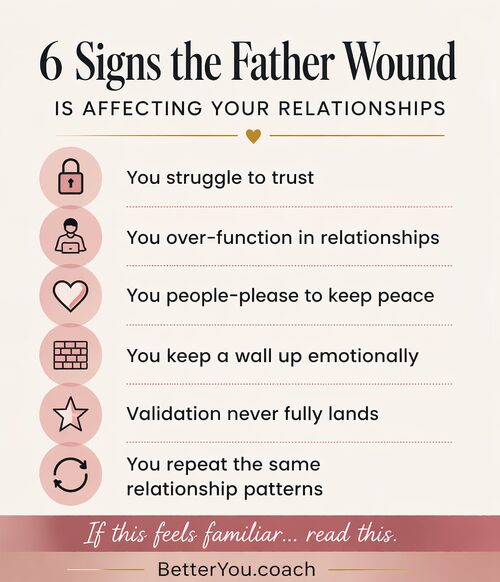
People-pleasing and difficulty with conflict
When the first safe masculine presence in your life was unpredictable — or simply not emotionally available — you learned quickly that keeping the peace was the wisest strategy. That learning doesn’t just disappear when you grow up.
A wall around your heart
You get close but not fully close. You love, but there’s a part of you still held back, still watching, still ready to retreat at the first sign of danger. This isn’t you being difficult. It’s you being protected — by a system that learned its job a very long time ago.
Seeking external validation that never quite lands
The praise doesn’t stick. The achievement doesn’t fill it. The relationship looks right on paper but something still feels hollow. When the original source of masculine validation felt unreliable, we can spend decades looking for it everywhere else — and never quite believing it when we find it.
Attracting the same kind of relationship, over and over
This one can be hard to hear. But what Kevin has observed, and what the research supports1, is that we tend to magnetize the people who highlight what most needs to be healed in us. The patterns repeat not because we’re broken, but because we’re being given another chance to finally resolve them.
| A Note for the Woman Who Had a Good Dad You may be reading this and thinking: this doesn’t quite fit. My dad was fine. He was present. He tried. That matters, and it’s worth holding. And — the father wound can live in the space between what was given and what was needed, not just in cases of obvious absence or harm. →A father who was emotionally unavailable even while being physically present. →A father who provided everything material but couldn’t access tenderness. →A father doing his very best through the lens of a generation that was never taught emotional language. →A divorce that put physical distance between you. →A father who simply didn’t know how to make a daughter feel seen. None of these make him a villain. All of them can leave a mark. If even a small part of this article resonates, it’s worth sitting with. Not to assign fault, but to understand yourself. |
Why Dads Didn’t Always Know Better And Why That Matters for Your Healing
One of the most freeing things you can do on this journey is understand the context your father was operating in.
Most of the men who became fathers in the 20th century were raised by men who had survived wars, depressions, and economic scarcity. Their model of fatherhood was provision: you keep the family safe, you put food on the table, you don’t complain, and you don’t stop. Emotional presence wasn’t part of the job description. In many cases, it was actively discouraged. Men who showed too much feeling were weak. Men who talked about their inner world were suspect.
That’s not an excuse. But it is an explanation. And understanding it changes the emotional texture of your own story.
| “Our fathers and grandfathers were in survival mode — from the wars, from everything they had to scrape for. Emotional life didn’t get to matter. That’s bled down into all of us.” — Kevin McNee |
When you can look at your father as a man who was also shaped by forces larger than himself. One who loved you in the only language he’d ever been taught. At that point, something in you can soften. Not instantly. Not completely. But enough to begin.
That softening isn’t just kind. It’s strategic. Holding tight to anger keeps the wound active. Understanding creates space for something new.
Get more conversations like this one, straight to your inbox
Weekly insights from the BetterYou coaching team — real talk, practical tools, and the kind of honesty that actually helps.
How the Father Wound Shows Up in Your Relationships Right Now
The father wound doesn’t stay in the past. It is, as Kevin puts it, an active shaping force in how you show up today. Here are some of the most common ways it plays out in adult relationships:
You expect your partner to be your father
Not consciously. But if you grew up with a father who made you feel loved, safe, and cherished, you may have unconsciously imported that template into your partnerships — and then been confused and disappointed when a real adult relationship couldn’t match it. Or if your father made you feel unsafe, you might find yourself recreating that dynamic with alarming consistency, wondering why the same type of person keeps appearing in your life.
You instruct when you want to connect
When trust in the masculine has been compromised, the tendency is to manage rather than receive. To direct rather than allow. To stay in control rather than risk vulnerability. This shows up as a woman who is strong, capable, and privately exhausted — because she’s doing the emotional labor for everyone in the room and calling it leadership.

You don’t believe the love that’s actually there
This is one of the most painful expressions of the wound. A partner who genuinely loves you, who is showing up, who is trying — and something in you can’t fully receive it. Not because it isn’t real. But because your nervous system was trained, long ago, not to trust what looks like safety.
You struggle to speak up when something isn’t working
Because somewhere inside, there’s still a small voice that remembers what happens when you make a man uncomfortable. That voice doesn’t know your relationship is different. It only knows what it learned.
Recognizing these patterns is not about pathologizing yourself. It’s about making something invisible visible — which is the only place healing can begin.
Where the Healing Actually Starts
The most important thing Kevin offered in our conversation was this: healing the father wound does not begin with your father. It begins with you.
Specifically, it begins with acknowledgment. Not dramatic acknowledgment. Not confrontation. Just the quiet, private admission: something happened, it affected me, and I’m allowed to feel that.
Step 1: Acknowledge it — without making anyone wrong
You don’t have to decide that your father failed you to acknowledge that you were affected. Both can be true. He loved you and he missed you. He tried and it wasn’t enough. He was doing his best and his best left a gap. Holding complexity is not weakness. It’s wisdom.
Step 2: Look at the story you made it mean
Here is where the real work lives. The wound itself is an event — or a pattern of events. What travels with you is the meaning you gave it as a child:
“I am not worth staying for.”
“I have to earn love.”
“I am too much.”
“I am not enough.”
When you can surface that story and examine it as an adult, something shifts. The story stops being truth and starts being an old interpretation — one you can revise.
Step 3: Write it down
Kevin’s personal practice — and one we recommend regularly — is to write. Not to perform, not to post, not to craft. To simply let the words come, even the unkind ones, even the messy ones. Holding pain internally keeps it circulating. Externalizing it — even on paper — interrupts the loop.2
Step 4: Reframe — but gently, and only after you’ve felt it
Reframing too soon is just suppression with better vocabulary. The sequence matters: first you acknowledge, then you feel, then you examine the story, and only then do you begin to wonder if another interpretation is possible.
“He was loving me in his own language.”
“He was doing what he knew.”
“This is his wound, passed down — and it stops with me.”
Step 5: Stop looking outside yourself for the validation that was missing
This is perhaps the most transformative step of all. The father wound, at its core, is a search for something that was supposed to come from one specific source and didn’t. Many women spend years — decades — looking for that missing validation in partners, in achievements, in the approval of others. The wound only begins to truly close when you can give yourself what you were looking for. When you can look at that younger version of you who needed to be seen, and see her yourself.
| “When we stop looking for validation from our father and start giving that to ourselves — when we can love those little versions of ourselves that needed it from our dads, then we can be free to attract the people who are more aligned with who we’re truly meant to be.” — Kevin McNee |
What About When Your Father Was Truly Harmful?
Some women reading this will have stories that go beyond emotional absence. Narcissism. Control. Cruelty. Actual harm. And those experiences deserve to be named differently — not minimized under the umbrella of “he was doing his best.”
If you grew up with a narcissistic parent, one of the most consistent patterns Kevin has observed is this: we tend to recreate the dynamic in our adult relationships. Not because we want to be hurt, but because the familiar, even when painful, registers to the nervous system as known. And known, to the survival brain, feels safer than unknown.3
If this is your story, a few things are worth knowing:
- Healing here is not about understanding your father’s pain so thoroughly that you lose sight of your own. Compassion for his wound and clarity about its impact on you are not mutually exclusive.
- When you become solid in yourself — genuinely self-validated, genuinely self-led — the people who once got in through the gaps in your armor can no longer reach you in the same way.
- Accepting that someone is who they are does not mean keeping them in your life. You can love someone, understand their limitations, release the hope that they’ll ever be different, and still choose distance. That is not coldness. That is, as Kevin calls it, loving from a distance. Which he describes as one of the most difficult and most necessary practices of his own life.
The Relationship Piece: When Your Wound Is Affecting Your Partnership
If you are in a relationship right now, and the patterns we’ve described feel familiar, there’s a specific, practical piece worth understanding.
Your wound is not your partner’s fault. But it is showing up in your partnership. And the way it’s most likely showing up is through a deficit of acknowledgment. Both yours toward your partner and the wound’s insistence that his isn’t enough.
This is not about lowering your standards. It’s about recognizing that when we are operating from a deficit of masculine trust, we tend to focus relentlessly on where our partner is failing. The laundry list of what he’s not doing while filtering out the evidence of what he is doing right.
Kevin’s insight here is powerful and practical: acknowledgment is the invitation that opens men up. When you shift from cataloguing what’s missing to genuinely noticing what’s there, something in the relationship often begins to change. Not because you’ve abandoned your needs — but because you’ve changed the energy in the room.4
And the deeper truth: the work always starts internally. You do your own work first. You understand your own patterns. You stop waiting for your partner to fix what your father left unfinished. And then clearly, honestly, without blame you communicate what you actually need.
That sequence matters. Do the internal work. Then communicate. Not the other way around.

A Note on Acceptance and What It Actually Means
One of the most important ideas in this entire conversation is the concept of acceptance and what it doesn’t mean.
Acceptance is not approval. It is not tolerance of harm. It is not pretending that what happened was fine.
Acceptance, in the healing sense of the word, means: I can acknowledge that this happened and choose not to carry it forward any further. It is the difference between releasing a weight and pretending the weight was never there. 5
When Kevin shared this insight in our conversation, it was one of those moments where the whole room went quiet. Because we had all been taught that letting go was something you did with your hands. That if you could just loosen your grip enough, the thing would fall away.
What he was describing was different. It’s an internal shift. It says: I see clearly what happened. I see clearly who that person is. And I am no longer going to allow that history to write my future.
That is the kind of acceptance that heals. Not because it erases the past, but because it stops letting the past vote on what comes next.
You Can’t Change What Happened. You Can Change What It Means.
Here is what we know, from years of coaching work and from every conversation we’ve had on The Better You Show: the woman who finds her way back to herself is not the one who had easier stories. She’s the one who was willing to look at her stories. REALLY look at them. And decide that the story didn’t have to be the ending.
The father wound is, at its core, a story about trust. Trust in men. Trust in safety. Trust in yourself. Trust in the idea that you are worth showing up for.
None of that is fixed by understanding it intellectually. It’s healed through experience. Through gradually, carefully choosing relationships and environments that offer what was missing, and allowing yourself to actually receive what’s offered.
That process rarely happens alone. And there is no shame in that. Some wounds are too old, too layered, and too embedded in your operating system to dissolve through sheer self-awareness. Sometimes you need a witness. Someone who can hold your story without flinching, ask the question that cracks something open, and walk beside you while you build the new one.
That is what coaching exists to do.
| Something Brought You Here If you read this far, something in this article spoke to you. That’s not an accident. It’s information. At BetterYou.coach, we work with the woman who is done living at half capacity — the woman who can feel that something in her story is still running things, and who is ready for that to change. Our free, no-obligation, connection call is not a sales pitch. It’s a conversation. You’ll leave it with more clarity than you came in with. About what’s actually going on, what’s possible, and whether coaching is the right next step for you. No pressure. No commitment. Just clarity and a path. Book your free connection call at: https://betteryou.coach |
About Kevin McNee
Kevin McNee is a men’s connection coach, mentor, and facilitator, and the founder of Men For More — a movement dedicated to helping men do the deep inner work of healing, presence, and heart-centered leadership.
Kevin has also worked with women navigating the father wound, the wounded masculine, and the impact of a life lived without a safe, trustworthy masculine presence. His perspective as a man who has done this work on himself, and who has witnessed its transformation in others, brings something rare and valuable to this conversation.
We are grateful to Kevin for his generosity, his honesty, and his willingness to go somewhere real.
You can find Kevin at:
www.menformore.com
Instagram: @creatingtheripple
Facebook: @creatingtheripple
References & Further Reading
The insights in this article emerge from lived coaching experience and are supported by the following research:
- Hazan, C. & Shaver, P. (1987). Romantic love conceptualized as an attachment process. Journal of Personality and Social Psychology, 52(3), 511–524. Research on adult attachment styles and how early caregiving relationships — including with fathers — shape adult relational patterns. AND Jilani, S., et al. (2022). Daughter-to-Father Attachment Style and Emerging Adult Daughters’ Psychological Well-Being. Psychological Reports. (Available via PMC.) ↩︎
- Pennebaker, J.W. & Beall, S.K. (1986). Confronting a traumatic event: Toward an understanding of inhibition and disease. Journal of Abnormal Psychology, 95(3), 274–281. Foundational research on expressive writing and its role in emotional processing and health outcomes. ↩︎
- Herman, J.L. (1997). Trauma and Recovery. New York: Basic Books. On complex trauma, repetition compulsion, and the survivor’s experience of recreating familiar relational dynamics. ↩︎
- Gottman, J.M. & Silver, N. (1999). The Seven Principles for Making Marriage Work. New York: Crown Publishers. On the role of positive acknowledgment in relationship repair and relational culture. ↩︎
- Linehan, M.M. (1993). Cognitive-Behavioral Treatment of Borderline Personality Disorder. New York: Guilford Press. On radical acceptance as a therapeutic concept — accepting reality as it is without approval or judgment, as a precondition for change. ↩︎
About the BetterYou Coaches
This article draws on a real conversation between coaches at BetterYou.coach — a coaching network dedicated to helping you thrive as your version of a better you.
- Coach Doris Efford (Host): Known as the Chaos Calmer, Doris is a Life Alignment Coach at BetterYou.coach, helping busy women create order, calm, and clarity in their lives——one phase-at-a-time.
- Counsellor Shelley McInroy: Shelley is a Registered Therapeutic Counsellor (RTC, ACCT) and Mental Wellness Coach at BetterYou.coach, offering a gentle, trauma-informed space to support women through anxiety, grief, burnout, and life transitions.
- Coach Tiffany Bayne: Tiffany (CLC, CHT, RSW) is a Mindset Coach and Certified Clinical Hypnotherapist at BetterYou.coach who helps women break through self-doubt and limiting belief blocks.
- Coach Joyce Erickson: Is known as the Happiness Igniter — a Happiness and Harmony Coach, Joyce helps women rediscover joy, rebuild presence, and bring lightness back into their everyday lives.
- Coach Sarah Rajkumar: is BetterYou.coach’s Transformational Leadership Coach. Sarah helps women step boldly into leadership and build businesses aligned with their purpose — through her signature Leadership with Love™ method.
Disclaimer
BetterYou.coach is a coaching network that matches people with their next right coach. We believe you’re not broken, you’re just human. And sometimes humans need support to thrive.
The Better You Show and any content posted by BetterYou.coach, Doris Efford, and/or any agents of BetterYou.coach is presented solely for general informational, educational, and entertainment purposes. The use of information from the aforementioned sources or materials linked is at the user’s own risk. It is not intended as a substitute for the advice of any professional and/or individualized advice. Users should not disregard or delay in obtaining professional advice for their individual condition or situation.
For personalized coaching, contact BetterYou.coach
Leave a Reply