
There’s a version of this you tell yourself — and it sounds completely reasonable. Once things settle down. Once the news gets less heavy. Once the kids launch, the job stabilizes, the uncertainty lifts. Then you’ll make the appointment. Start the thing. Say yes to what you actually want.
It makes sense on the surface. But if you’re honest, you’ve been saying some version of this for a while now. And the life you keep meaning to get back to? It’s still waiting.
In This Article
- Episode 28 of The Better You Show
- Why Waiting for Stability Is the Trap Nobody Warns You About
- What Is “Outsourcing Your Stability” and Are You Doing It?
- What Fear Is Actually Doing When You Feel Stuck
- How to Build Inner Stability When Nothing Outside Feels Safe
- Does Limiting News and Social Media Actually Help?
- Why Community Is One of the Most Underrated Stability Tools
- What It Looks Like to Actually Stop Waiting
- What Would It Feel Like To Stop Waiting And Actually Live?
- Meet The Coaches
- References & Deeper Reading
Episode 28 of The Better You Show
This article was inspired by a real conversation had on The Better You Show. Want to hear it straight from our coaches? Watch the full episode here then keep reading for the expansion.
Why Waiting for Stability Is the Trap Nobody Warns You About
Waiting for external calm before investing in your own life is one of the quietest ways to lose time. The logic feels protective — don’t make big moves when everything is uncertain — but what it actually does is hand over the authorship of your life to conditions you cannot control.
Counselor Shelley McInroy puts it plainly: when we outsource the starting signal to the outside world, we stop living our own lives. We’re not being careful. We’re just not showing up.
The harder truth? There will always be something. There has always been something. The people who build lives they actually want aren’t the ones who found a calm window. They’re the ones who stopped waiting for it.

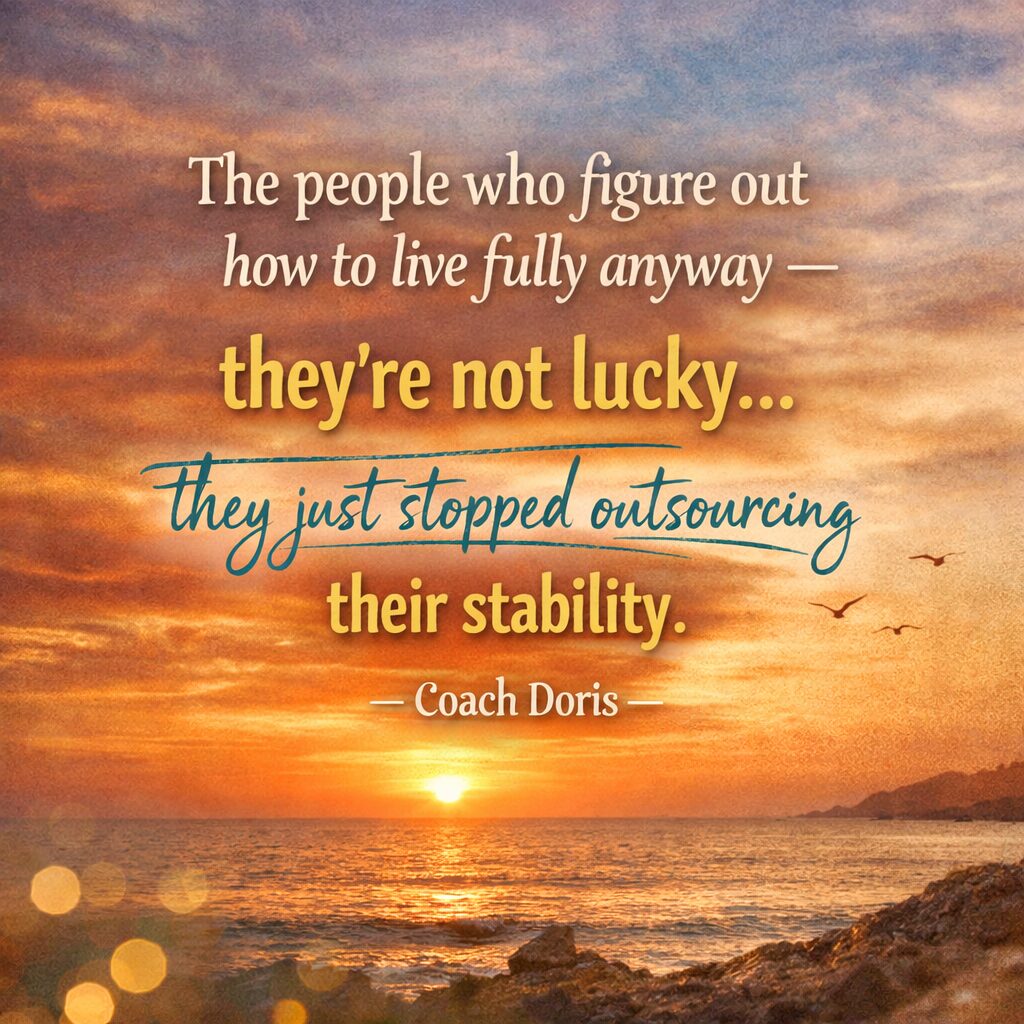
“The people who figure out how to live fully anyway — they’re not lucky, they’re not unaffected. They just stopped outsourcing their stability to circumstances they can’t control.”
— Coach Doris
What Is “Outsourcing Your Stability” and Are You Doing It?
Outsourcing your stability means letting the state of the world — the economy, the news cycle, your family’s needs, the general mood of everything — determine whether you have permission to invest in yourself.
It shows up in small ways. Putting off the conversation. Delaying the decision. Telling yourself it’s not the right time, when really, you’ve forgotten what the right time would even feel like.
Coach Sarah Rajkumar points to identity as the root: two people can be sitting in the exact same circumstances, facing the exact same uncertainty, and respond completely differently. The difference isn’t luck or resilience. It’s the story each one is running about who she is and what she’s capable of.
A note for the woman who thinks this isn’t about her:
If your life looks fine on paper — you have a good family, a solid job, no obvious crisis — and you still feel like there’s something that needs to change when the time is right. This is the article. The waiting doesn’t always look like paralysis. Sometimes it looks exactly like competence.
What Fear Is Actually Doing When You Feel Stuck
Fear is the mechanism behind the waiting. Not the loud, obvious kind — but the quieter fear that lives underneath: fear of going back to something you barely survived, fear of losing what little stability you’ve built, fear of trying something and proving the doubt right.
Nicky Yazbeck, a licensed clinical social worker with nearly 30 years of experience, identifies this as the critical question: what specifically are you afraid of? Poverty? Abandonment? Losing your identity? The answer matters because most of us carry a fear that formed somewhere much earlier than the current circumstances.
When you don’t examine that fear directly, your nervous system treats uncertainty as danger1 — and it responds accordingly. Every unfamiliar choice, every risk, every investment in yourself gets filtered through that alarm system. Not because it’s actually dangerous. Because it feels like something that once was.
“Sometimes we’re afraid. What if I do this and it doesn’t work? But what if you don’t? If you don’t do anything, nothing will change.”
— Counselor Shelley McInroy
How to Build Inner Stability When Nothing Outside Feels Safe
Inner stability is not a personality trait some people have and others don’t. It’s something you build — through small, consistent actions that create evidence that you can trust yourself.2
Mindset coach and hypnotherapist Tiffany Bayne describes this as building what she calls internal certainty: learning to regulate your nervous system, working with the subconscious patterns that equate uncertainty with danger, and slowly accumulating proof that you are, in fact, someone who can handle what comes.
The key word is slowly. Not a massive overhaul. Not a declaration. Small moves. Tiffany’s framework: practice something for five minutes a day before you try ten.3 Sit outside in nature twice a week before you commit to a daily walk. Set goals that are achievable, then actually achieve them. The evidence compounds.4
What this looks like in practice
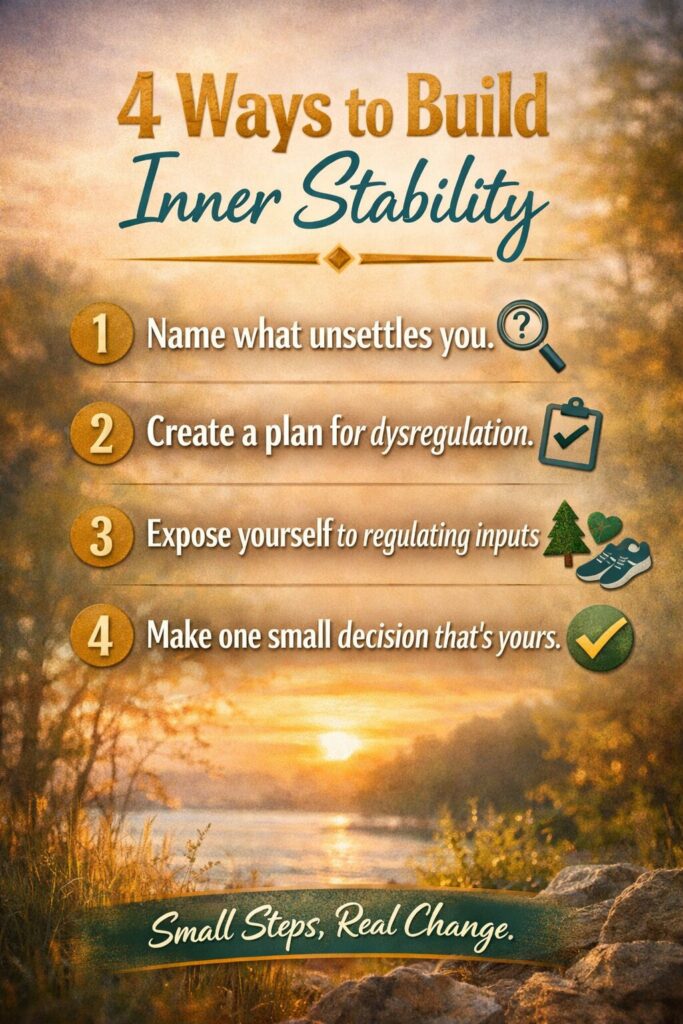
- Name what specifically unsettles you — not the general state of the world, but the particular fear underneath it
- Create a plan for what you’ll do when you feel dysregulated — before you’re in that state
- Expose yourself to regulating inputs (nature, movement, play, community) rather than more of what already alarms your system
- Make one small decision this week that is genuinely yours — not driven by what would make others comfortable
Does Limiting News and Social Media Actually Help?
Yes — with an important distinction. The goal is not to avoid the world. It’s to manage your nervous system’s exposure to content that is designed to keep it activated.
Nicky is direct: intentional fear in media has an agenda. It is not neutral information. Her own practice involves a limited, intentional intake — staying broadly informed without going down the rabbit hole. “Find the level where you’re not getting dysregulated,” she says. That level is different for everyone, but most people haven’t consciously chosen it.
The research backs this up. Studies consistently show that high news consumption correlates with elevated anxiety and lower sense of personal control.5 6 The irony is that the more destabilized you feel, the harder it is to take the action that would actually improve your situation.
Why Community Is One of the Most Underrated Stability Tools
Isolation is one of the fastest routes to depression, and community is one of the most direct antidotes7. This is not metaphorical — it’s physiological.8 Human nervous systems are wired to co-regulate. Being with the right people literally calms your body down. 9
Nicky’s guidance here is specific: community means people who feel good to your nervous system, not people who amplify your anxiety. She distinguishes between the gathering that leaves everyone more activated (because the entire conversation is about what’s wrong) and the one that actually restores something.
It also means reaching out before the crisis. Coaching. Therapy. A conversation with someone who can see what you can’t see in yourself. Coach Sarah describes coaches as your blind spot — someone positioned outside your own fear response who can reflect back what you’re missing.
“When we feel alone, that’s when depression sets in. Build the community that feels good to your nervous system.”
— Nicky Yazbeck, LCSW
Let’s Keep In-Touch
A small note from us each week delivered to your inbox Wednesdays.
What It Looks Like to Actually Stop Waiting
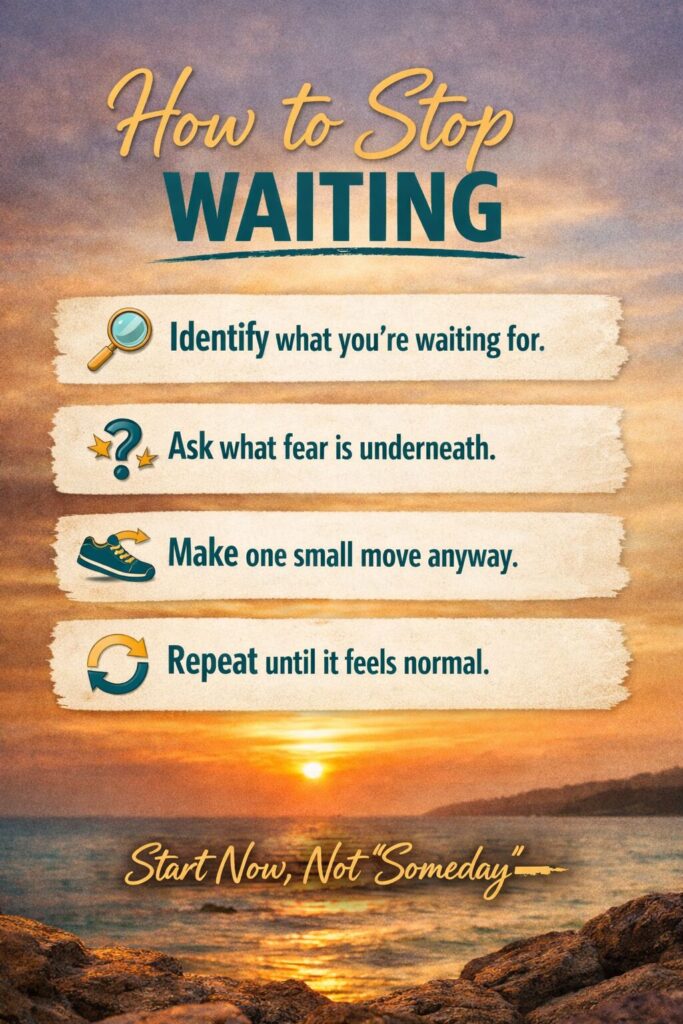
This isn’t about suddenly having courage you didn’t have before. It isn’t about deciding the world has calmed down enough to proceed. It’s a subtler shift — from waiting for external permission to building internal permission, one small move at a time.
Joyce Erickson, BetterYou.coach’s Happiness and Harmony Coach, names what’s often at the root of the waiting: fear of going back. Not fear of failure, exactly, but fear of regression. Of losing ground you’ve worked hard for. The antidote, she says, is staying focused on what you want, not on what everyone else says you should want. Following your own signal, not the noise.
That’s what stops the waiting. Not a grand pivot. Not a perfect plan. Just the decision to stop letting the outside world cast the deciding vote on your own life.
What Would It Feel Like To Stop Waiting And Actually Live?
A free connection call at BetterYou.coach isn’t a sales call. It’s a real conversation to get a clear picture of your whole life — where you’re thriving, where you’re stuck, and what actually needs attention first. All before you commit to anything.
No pressure. No pitch. Just clarity, a real conversation, and a sense of what’s actually possible for you.
Book your free connection call: betteryou.coach
Meet The Coaches
Guest Nicky Yazbeck, LCSW
Nicky Yazbeck is a licensed clinical social worker with nearly 30 years of experience working alongside people in their most honest and difficult moments. She is a trauma-informed therapist integrating multiple therapeutic modalities, and the host of the Connected Community Podcast: Exploring Possibility.
- Website: nickyyyoga.com/therapy-sessions
- YouTube: The Connected Community
- Instagram: @kambo_mama
Meet the BetterYou.coach Team
This article draws on a real conversation between coaches at BetterYou.coach — a coaching network dedicated to helping you thrive as your version of a better you.
- Coach Doris Efford (Host): Known as the Chaos Calmer, Doris is a Life Balance Coach at BetterYou.coach, helping busy women create order, calm, and clarity in their lives——one phase-at-a-time.
- Counsellor Shelley McInroy: Shelley is a Registered Therapeutic Counsellor (RTC, ACCT) and Mental Wellness Coach at BetterYou.coach, offering a gentle, trauma-informed space to support women through anxiety, grief, burnout, and life transitions.
- Coach Tiffany Bayne: Tiffany (CLC, CHT, RSW) is a Mindset Coach and Certified Clinical Hypnotherapist at BetterYou.coach who helps women break through self-doubt and limiting belief blocks.
- Coach Joyce Erickson: Is known as the Happiness Igniter — a Happiness and Harmony Coach, Joyce helps women rediscover joy, rebuild presence, and bring lightness back into their everyday lives.
- Coach Sarah Rajkumar: is BetterYou.coach’s Transformational Leadership & Abundance Coach. Sarah helps women step boldly into leadership and build businesses aligned with their purpose — through her signature Leadership with Love™ method.
Find your coach: betteryou.coach
References & Deeper Reading
- Dugas, M. J., & Robichaud, M. (2007). Cognitive-behavioral treatment for generalized anxiety disorder: From science to practice. Routledge. ↩︎
- Jacobson, N. S., Martell, C. R., & Dimidjian, S. (2001). Behavioral activation treatment for depression: Returning to contextual roots. Clinical Psychology: Science and Practice, 8(3), 255–270. ↩︎
- Fogg, B. J. (2019). Tiny Habits: The small changes that change everything. Houghton Mifflin Harcourt. ↩︎
- Bandura, A. (1977). Self-efficacy: Toward a unifying theory of behavioral change. Psychological Review, 84(2), 191–215. ↩︎
- McLaughlin, B., & Velez, J.A. (2019). Reading the news and feeling anxious: The relationship between news consumption and anxiety. Journalism & Mass Communication Quarterly, 96(4), 1073–1089. ↩︎
- Bendau, A., Petzold, M. B., Pyrkosch, L., Mascarell Maricic, L., Betzler, F., Rogoll, J., Große, J., Ströhle, A., & Plag, J. (2021). Associations between COVID-19 related media consumption and symptoms of anxiety, depression and COVID-19 related fear in the general population in Germany. European Archives of Psychiatry and Clinical Neuroscience, 271, 283–291. ↩︎
- Holt-Lunstad, J., Smith, T. B., & Layton, J. B. (2010). Social relationships and mortality risk: A meta-analytic review. PLoS Medicine, 7(7), e1000316. ↩︎
- U.S. Surgeon General. (2023). Our epidemic of loneliness and isolation: The U.S. Surgeon General’s advisory on the healing effects of social connection and community. ↩︎
- Porges, S.W. (2011). The Polyvagal Theory: Neurophysiological Foundations of Emotions, Attachment, Communication, and Self-regulation. W.W. Norton & Company. ↩︎
Disclaimer
BetterYou.coach is a coaching network that matches people with their next right coach. We believe you’re not broken, you’re just human. And sometimes humans need support to thrive.
The Better You Show and any content posted by BetterYou.coach, Doris Efford, and/or any agents of BetterYou.coach is presented solely for general informational, educational, and entertainment purposes. The use of information from the aforementioned sources or materials linked is at the user’s own risk. It is not intended as a substitute for the advice of any professional and/or individualized advice. Users should not disregard or delay in obtaining professional advice for their individual condition or situation.
For personalized coaching, contact BetterYou.coach
Leave a Reply