

When you hit midlife, your body starts sending signals you can’t ignore anymore. Your A1C creeps up, your energy dips, your stress tolerance shrinks, and suddenly your doctor is talking about prediabetes like it’s just another Tuesday.
But here’s the truth no one warns us about:
Your physiology changed — and the rules you lived by for decades don’t apply anymore.
Midlife women aren’t dealing with “slowing down.” They’re dealing with a triple threat that dramatically shifts how the body handles blood sugar:
Cortisol. Sex Hormones. Insulin Resistance.
And two amplifiers make the whole thing even harder:
- Muscle loss
- Sleep disruption
This article breaks down what’s actually happening inside your midlife body — and the small, doable lifestyle swaps that actually help lower A1C.
In This Article
- Episode 40 of The Better You Show
- The Triple Threat
- 1. Cortisol: The Stress Hormone That Hijacks Midlife Blood Sugar
- 2. Sex Hormones: The Metabolic Shift No One Prepares You For
- 3. Insulin Resistance: The Midlife Metabolic Slowdown
- The Two Amplifiers That Make the Triple Threat Worse
- The Lifestyle Swaps That Actually Lower A1C in Midlife
- Why This Same Triad Increases Risk for Other Chronic Conditions
- You’re Not Broken — You’re in a New Season
- The Research Behind This Article
Episode 40 of The Better You Show
This article was inspired by this episode where Erica Church Oliver and the BetterYou.coach coaches break down the connection between stress, hormones, and blood sugar — and why midlife women often feel blindsided by rising A1C. If you’ve ever wondered why your numbers changed seemingly overnight, this episode gives you the “aha” moment you’ve been missing.
The Triple Threat
Most women are told their rising A1C is ONLY about carbs, sugar, or “trying harder.”
That advice is outdated — and honestly, insulting. The real story is biochemical on a systematic scale.
- Cortisol dysregulation
- Sex hormone decline (estrogen + progesterone)
- Insulin resistance
These three systems are deeply interconnected, and in midlife, they stop playing nicely together.
Let’s break it down.
1. Cortisol: The Stress Hormone That Hijacks Midlife Blood Sugar
Cortisol isn’t the villain — in fact, it is necessary in the right amounts and at the right times. Unfortunately, in midlife, it becomes unbuffered.
Estrogen used to soften your stress response. It acted like a natural shock absorber for your stress response. When it’s abundant, your brain doesn’t react as intensely to stress signals, your cortisol spikes are smaller, and your body returns to baseline more quickly. As estrogen declines in midlife, that buffer disappears — so everyday stress hits harder, cortisol stays elevated longer, and its impact on blood sugar becomes much more noticeable.
In short…You’re flying without that safety net.
What rising cortisol does to your blood sugar:
- Signals your liver to release stored glucose
- Makes your cells more insulin‑resistant
- Raises fasting blood sugar
- Disrupts sleep (which raises A1C further)
- Increases belly fat (cortisol’s favorite storage site)
This is why so many midlife women say:
“I swear I’m not eating differently — but my numbers keep going up.”
You’re not imagining it. You’re not failing. Your physiology is shifting.
2. Sex Hormones: The Metabolic Shift No One Prepares You For

Estrogen and progesterone aren’t just reproductive hormones — they’re metabolic regulators.
When estrogen drops:
- Insulin sensitivity decreases
- Blood sugar spikes more easily
- Appetite cues change
- Fat distribution shifts to the abdomen
- Sleep becomes lighter and more fragmented
When progesterone drops:
- You lose its calming, anti‑inflammatory effect
- Cortisol becomes more reactive
- You feel wired, tired, or both
This hormonal environment makes blood sugar harder to manage. Even if your habits haven’t changed.
3. Insulin Resistance: The Midlife Metabolic Slowdown
Insulin isn’t the problem — insulin resistance is.
Midlife women naturally experience:
- Lower muscle mass
- Higher visceral fat
- More reactive cortisol
- Less stable glucose response
This creates a perfect storm where your body struggles to move glucose into cells efficiently, causing A1C to rise.
The Two Amplifiers That Make the Triple Threat Worse
Amplifier #1: Muscle Loss (Sarcopenia)
Muscle is the #1 site of glucose disposal.
Less muscle → less glucose uptake → higher blood sugar → higher A1C.
This is why strength training is one of the most powerful tools for midlife metabolic health.
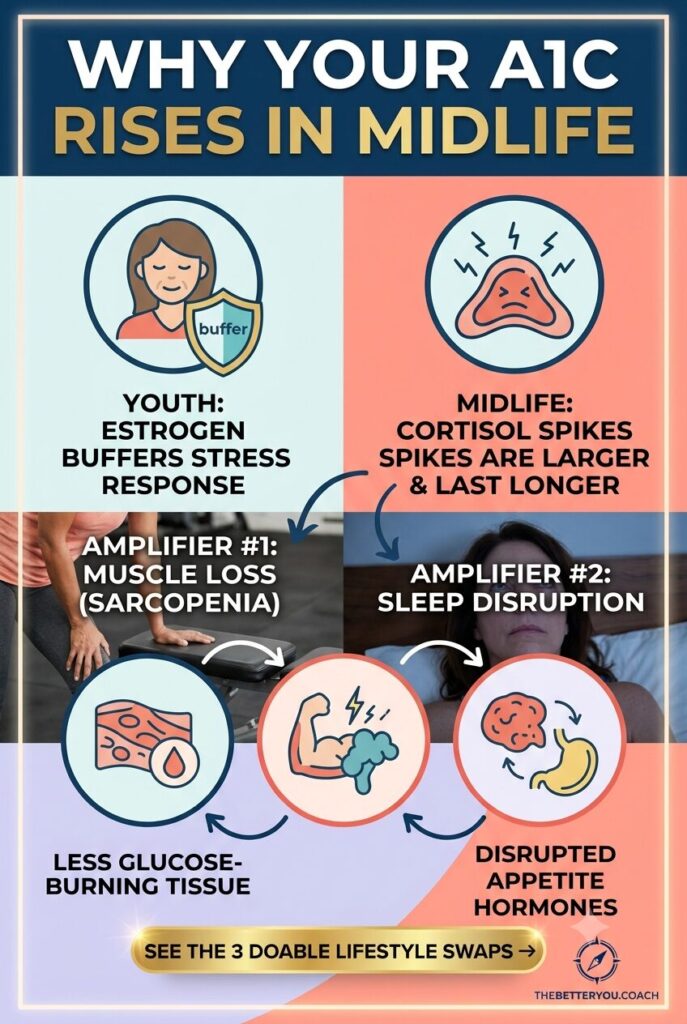
Amplifier #2: Sleep Disruption
Sleep is the metabolic switchboard.
Poor sleep:
- Raises cortisol
- Increases insulin resistance
- Disrupts appetite hormones
- Raises fasting glucose
- Raises A1C
Midlife sleep changes are hormonal and are often influenced by stress, environment, pain, alcohol, caffeine, and sleep habits also matter.
The Lifestyle Swaps That Actually Lower A1C in Midlife
Here’s the good news: You don’t need a full lifestyle overhaul. You need targeted swaps that work with your midlife physiology.
Below are expanded versions of Erica’s suggestions — tailored specifically for perimenopause and menopause.

Swap #1: Eat Protein Before Coffee
Coffee on an empty stomach spikes cortisol. Eat 10–15g of protein first, then have your coffee.
Examples:
- A boiled egg
- A small protein shake
- Greek yogurt
- Cottage cheese
This stabilizes blood sugar and reduces cortisol’s impact.
Swap #2: Add a 10‑Minute Post‑Meal Walk
This is one of the most powerful A1C‑lowering tools for midlife women.
A short walk:
- Lowers post‑meal glucose
- Improves insulin sensitivity
- Reduces cortisol
- Supports digestion
You don’t need a gym. You need 10 minutes — indoor or out.
Swap #3: Increase Protein Per Meal
Midlife women need more protein — not for weight loss, but for:
- Blood sugar stability
- Muscle preservation
- Hormone support
- Satiety
- Energy
Aim for 90–120g per day depending on your body size and activity level. Most midlife women thrive on about 0.7–1.0 grams of protein per pound of body weight. Your exact number depends on how active you are — especially whether you strength train. If you’ve heard “0.75g per pound,” that’s right in the sweet spot for women who walk regularly, lift a couple times a week, or simply want to support muscle, blood sugar, and hormone balance in midlife. If you are an athlete, you need more.
Swap #4: Add Magnesium Glycinate at Night
Magnesium supports:
- Sleep
- Cortisol regulation
- Blood sugar control
- Muscle relaxation
Magnesium defiency is common since reports are showing a decrease of magnesium in soil.
Swap #5: Swap HIIT for Strength + Zone 2
HIIT (High Intensity Interval Training) and long, sustained high‑intensity cardio spike cortisol — and midlife women already have elevated cortisol. Instead of pushing harder, your physiology responds better to training that supports blood sugar, hormones, and recovery.
Better options for midlife metabolism:
Strength training 2–3x/week Builds muscle (your #1 glucose‑burning tissue) and improves insulin sensitivity.
Zone 2 cardio 2–3x/week (20–45 minutes) This is the “working but still able to talk” pace where your talking is a little breathy. Things like fast walking, cycling, elliptical, or hiking. Zone 2 lowers cortisol, stabilizes blood sugar, and improves metabolic flexibility without stressing your system.
Pilates Supports core strength, mobility, and nervous system regulation.
Yoga Reduces cortisol, improves sleep, and supports recovery.
These forms of movement help lower A1C, support hormone balance, and protect your metabolism — without the cortisol spikes that make midlife symptoms worse.
Swap #6: Pair Carbs With Protein and Fat
This slows glucose absorption and prevents spikes.
Examples:
- Apple + peanut butter
- Toast + eggs
- Rice + salmon
- Pasta + chicken + olive oil
You don’t need to cut carbs — you need to pair them.
Swap #7: Treat Sleep Like Medicine
Because it is.
Even small improvements in sleep can dramatically lower cortisol and stabilize blood sugar.
Why This Same Triad Increases Risk for Other Chronic Conditions
The triple threat doesn’t just affect A1C — it influences nearly every chronic condition common in midlife women.
Conditions impacted by cortisol + hormone decline + insulin resistance:
- Metabolic syndrome
- Type 2 diabetes
- Cardiovascular disease
- NAFLD (fatty liver)
- Thyroid dysfunction
- Autoimmune flares
- Mood disorders
- Cognitive decline

This is why midlife women often feel like everything is happening at once — because metabolically, it is.
But once you understand the pattern, you can make the swaps, intervene early, and effectively.
You’re Not Broken — You’re in a New Season
Midlife isn’t a decline. It’s a recalibration.
Your body isn’t betraying you — it’s communicating with you.
And once you understand the triple threat of cortisol, sex hormones, and insulin resistance (plus the amplifiers of muscle loss and sleep disruption), you can make small, powerful shifts that bring your A1C back into a healthy range.
The Research Behind This Article
American Diabetes Association Professional Practice Committee. (2024). Diagnosis and Classification of Diabetes: Standards of Care in Diabetes—2024. Diabetes Care. Supports A1C thresholds and the article’s discussion of prediabetes and glycemic classification.pubmed.ncbi.nlm.nih
American Diabetes Association. (2024). Diabetes Diagnosis & Tests. American Diabetes Association. Provides a clear, reader-friendly source for A1C ranges, including prediabetes.diabetes
The Menopause Society. (2024). New Meta-Analysis Shows That Hormone Therapy Can Significantly Reduce Insulin Resistance. The Menopause Society. Supports the link between menopause-related hormone change and insulin resistance.menopause
Singh, P., et al. (2023). Effect of Sleep Restriction on Insulin Sensitivity and Energy Metabolism in Postmenopausal Women: A Randomized Crossover Trial. Obesity. Direct support for the claim that sleep loss can worsen insulin sensitivity in postmenopausal women.pubmed.ncbi.nlm.nih
Nygaard, B., et al. (2009). Slow Postmeal Walking Reduces Postprandial Glycemia in Older Adults at Risk for Glucose Intolerance. Journal of Applied Physiology. Supports the recommendation for a short walk after meals to reduce glucose spikes.pubmed.ncbi.nlm.nih
Riddell, M. C., et al. (2018). Sleep, Health, and Metabolism in Midlife Women and Menopause: Food for Thought. Obstetrics & Gynecology Clinics of North America. Supports the section explaining how menopause-related sleep changes can affect metabolic health.
Disclaimer
BetterYou.coach is a coaching network that matches people with their next right coach. We believe you’re not broken, you’re just human. And sometimes humans need support to thrive.
The Better You Show and any content posted by BetterYou.coach, Doris Efford, and/or any agents of BetterYou.coach is presented solely for general informational, educational, and entertainment purposes. The use of information from the aforementioned sources or materials linked is at the user’s own risk. BetterYou.coach may be compensated for any links on its site. Information and links on this site are not intended as a substitute for the advice of any professional and/or individualized advice. Users should not disregard or delay in obtaining professional advice for their individual condition or situation.
For personalized coaching, contact BetterYou.coach.
Leave a Reply