“I don’t know what I want, but I know it isn’t this.”
If you’ve ever whispered those words to yourself in the shower, in your car, or while staring at your ceiling at 2 a.m., I want you to know something important:
You’re not lost.
You’re not broken.
You’re not behind.
You’re standing at the exact doorway
every major life transformation begins with.
And despite what the internet tells you, you don’t need a ten‑year plan, a color‑coded vision board, or a perfectly articulated purpose to walk through it.
You just need to understand what’s actually happening inside you when you say, “I don’t know what I want.”
Because here’s the truth most people never learn:
Not knowing what you want is rarely confusion.
It’s usually protection.
In This Article
- Episode 39 of The Better You Show
- The Lie Your Brain Tells You When You’re Standing at a Threshold
- Your Body Knows Before Your Mind Does
- The Inverse Compass: How “Not This” Shows You Exactly What You Want
- Why You’re Afraid to Want What You Want
- Micro‑Experiments: The Science‑Backed Way Out of Stuckness
- The Real Reason You’re Stuck Isn’t Confusion — It’s Permission
- If You Want Support Turning “Not This” Into Your Next Chapter
- Research Behind This Article
- Disclaimer
Episode 39 of The Better You Show
This episode breaks open the quiet panic behind the words, “I don’t know what I want, but I know it isn’t this,” and shows you why that sentence is never a dead end — it’s the beginning of your next chapter. If you’ve been feeling stuck, suffocated, or strangely disconnected from the life you built, this is the perfect place to start.
The Lie Your Brain Tells You When You’re Standing at a Threshold
When people write to us saying, “I don’t know what I want, but I know it isn’t this,” they’re almost always describing the same internal experience:
A quiet panic. A tightening in the chest. A sense of suffocation. A fear of choosing wrong. A fear of disappointing someone. A fear of blowing up the life they built… even if it feels a little like a prison.
And then when asked what they do want, the brain steps in with its favorite self‑protective sentence:
“I don’t know.”
Your brain isn’t evil for saying ‘I don’t know’—it’s just doing its job a little too well. Research in neuroscience and behavioral psychology shows your brain is wired to minimize threat and uncertainty. When a choice feels risky or life‑shifting, it often defaults to avoidance or indecision. That can absolutely sound like, ‘I don’t know.’ That’s not weakness. That’s your inner safety system trying to keep you from walking off a cliff it thinks is there.
Your brain is wired for predictability. Predictability equals survival. Change equals risk.
So when you get close to admitting what you truly want, your brain throws a smoke bomb:
“I don’t know.”
Not because you’re confused. But because knowing would require action. And action would require courage. And courage would require disrupting the familiar.
Your brain isn’t trying to sabotage you. It’s trying to protect you. As Dr. Lisha Antiqua said in one of our podcasts, “even if that means killing off the vessel.”1
But your body? Your body already knows the truth.

Your Body Knows Before Your Mind Does
Have you noticed how your shoulders tense when you walk into that office? Or how your stomach drops on Sunday nights? Or how your energy disappears around certain people?
Your body is not dramatic—it’s data-driven. Damasio’s somatic marker hypothesis shows that bodily signals (tight shoulders, stomach drops, that Sunday-night dread) can guide your decisions before your conscious mind can fully explain what’s going on. So when your body screams ‘not this,’ it’s not being negative. It’s waving a flag that says, ‘Pay attention, sis. Something here doesn’t line up with your survival and wellbeing.
Your body is screaming:
“Not this.”
And that’s not negativity. That’s data.
Your dissatisfaction is not a failure. It’s a compass.
The Inverse Compass: How “Not This” Shows You Exactly What You Want
Most people try to figure out their future by imagining their dream life. And if you can see it, if you know what you want and this works for you, keep doing that.
But when you’re overwhelmed, burnt out, or disconnected from yourself, imagining a dream life can feel impossible.
So instead, we flip the process.
We use the Inverse Compass. It’s a framework rooted in research in emotional agility which suggests that difficult emotions and deep dissatisfaction are not just noise—they’re information about unmet needs or misalignment. Interpreting ‘what feels wrong’ can help you get clearer on what you actually want, even if it doesn’t map perfectly to a neat opposite.
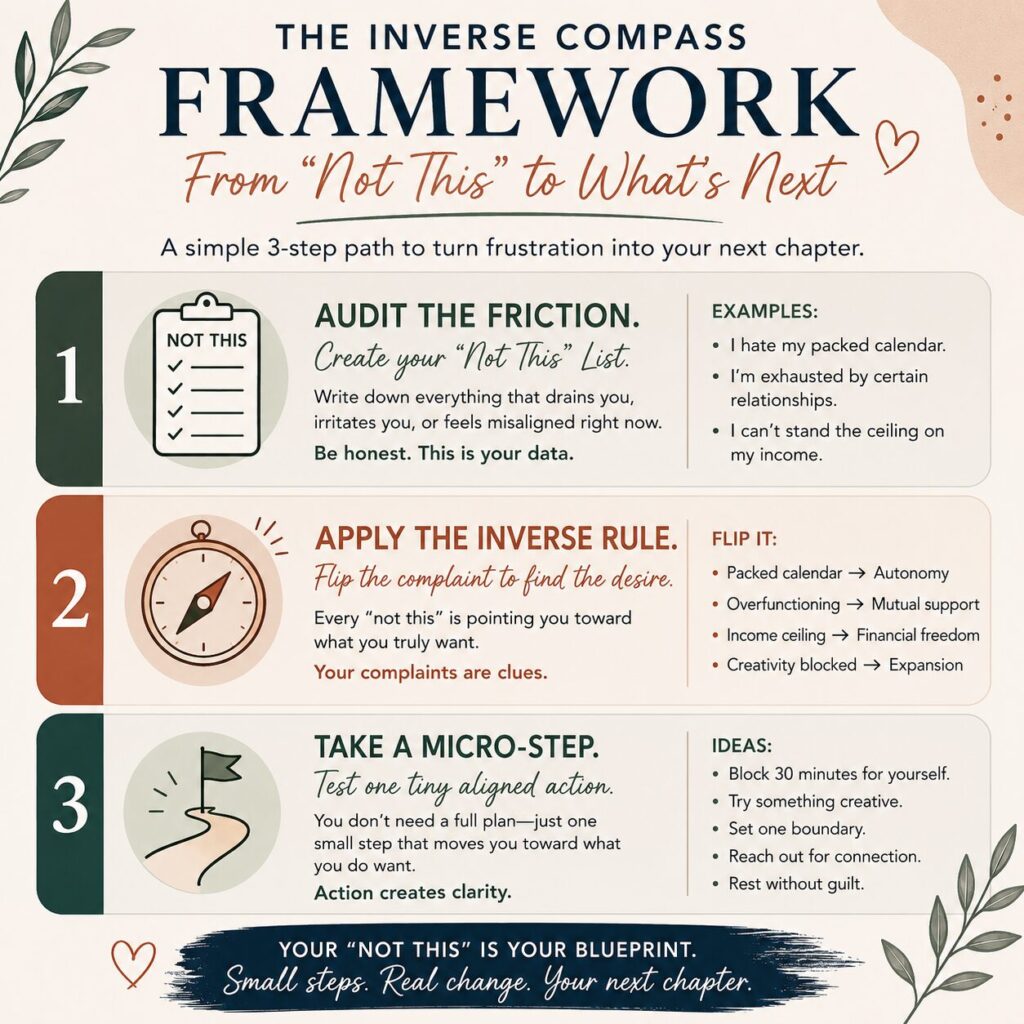
- If you don’t want a packed calendar, you might want autonomy.
- If you don’t want to overfunction in relationships, you might want mutual support.
- If you don’t want to feel creatively suffocated, you might want expansion.
- If you don’t want to be the emotional shock absorber for everyone around you, you might want reciprocity.
Your complaints are not negativity. They are baseline desires in disguise.
Your frustration is a map. Your exhaustion is a clue. Your resentment is a boundary. Your boredom is a calling. Your ‘not this’ isn’t a failure to dream; it’s a starting point. It’s you saying, ‘I know what doesn’t fit me anymore,’ which is honestly half the battle. Your “not this” is your blueprint.
Why You’re Afraid to Want What You Want
Let’s be real: you’re not confused—you’re cautious. Decades of research on decision-making, loss aversion, and fear of evaluation show that people naturally over-weight potential losses and social risks compared to gains.
Wanting something new means:
- admitting the current version of your life isn’t working
- risking disappointing people
- risking judgment
- risking failure
- risking change
- risking being seen
- risking being misunderstood
- risking being selfish (even though you’re not)
Of course parts of you hit the brakes. That’s not you being broken. That’s you being human in a world that punishes people for wanting boldly.
But here’s the thing:
You don’t need to know the final destination to step out of a space that’s suffocating you.
You just need one tiny step.

Micro‑Experiments: The Science‑Backed Way Out of Stuckness
Harvard Business School discovered something called The Progress Principle. Amabile and Kramer’s research shows that making small, meaningful progress is one of the most consistent drivers of motivation and positive emotion, especially in work and goal-directed areas of life. That’s why micro-experiments work. You don’t need a full life overhaul to feel alive again.
You need one tiny, aligned action that proves to your nervous system, ‘I can move, and the world doesn’t end.’ Every small win whispers back: ‘You’re not stuck. You’re in motion.
You don’t need to quit your job. You don’t need to blow up your marriage. You don’t need to move across the country.
You need one small, low‑stakes action that aligns with the baseline desire your “not this” revealed.
- If you crave autonomy: Block 30 minutes this week that no one is allowed to touch.
- If you crave creativity: Buy a $10 watercolor set or write one paragraph before bed.
- If you crave connection: Text someone who feels safe and say, “Want to grab coffee?”
- If you crave rest: Sit down for five minutes and work on a breathing exercise or meditate. Rest is productive.
This lines up with what we see in behavioral activation and action research: movement often creates clarity faster than overthinking ever will. You don’t need to perfectly understand your purpose before you take one honest step. You just need to do something that feels slightly more like you. Action gives your brain new data, and new data gives you new options. Translation: stop waiting to ‘figure it all out’ and start testing what feels more alive.
The Real Reason You’re Stuck Isn’t Confusion — It’s Permission
You don’t need a master plan. You don’t need certainty. You don’t need confidence.
You need permission.
Permission to want what you want. Permission to stop tolerating what drains you. Permission to experiment. Permission to change your mind. Permission to evolve. Permission to outgrow the life you built when you were a different version of yourself.
In practice, a lot of what looks like confusion is actually hesitation to act on what you already sense, especially when change carries social or emotional risk. You don’t always need more certainty. Sometimes you need to stop pretending you don’t already know that something has to shift. Permission isn’t magic—it’s you deciding that your discomfort matters enough to act on, even if the plan isn’t perfect.

If You Want Support Turning “Not This” Into Your Next Chapter
If you’re sitting with a list of “not this” items swirling in your head and you want a structured, safe space to translate those signals into a custom roadmap, we can help.
A connection call is the easiest place to start. It’s a no-pressure, no-commitment conversation that will, at minimum give you clarity and a next step.
Start here: https://betteryou.coach/start
You’re not confused. You’re awakening.
You’re not failing. You’re evolving.
You’re not stuck. You’re standing at the doorway of your next chapter.
And you deserve to walk through it.
Please take care.
Research Behind This Article
David, S. (2016). Emotional Agility. Avery Publishing. Explains how accurately naming difficult emotions down‑regulates the nervous system and increases clarity.
Damasio, A. (1994). Descartes’ Error: Emotion, Reason, and the Human Brain. Putnam. Introduces somatic markers and how the body signals truth before the mind can articulate it.
Amabile, T., & Kramer, S. (2011). The Progress Principle. Harvard Business Review Press. Shows that small wins are the strongest driver of motivation and forward momentum.
LeDoux, J. (1996). The Emotional Brain. Simon & Schuster. Explains the threat detection system and why the brain resists change.
Baumeister, R. F., & Vohs, K. D. (2016). Strength Model of Self-Regulation as Limited Resource. Advances in Experimental Social Psychology. Updated overview showing how mental effort and self-control limits can shape avoidance, while acknowledging ongoing debate.
Kool, W., & Botvinick, M. M. (2016). Decision Making and the Avoidance of Cognitive Demand. Journal of Experimental Psychology: General. Evidence that people systematically avoid high mental effort choices, which can show up as “I don’t know.
Picciotto, G., & Fabio, R. A. (2023). Does stress induction affect cognitive performance or avoidance of cognitive effort? Stress and Health. Shows acute stress increases preference for less demanding options, even without big performance drops.
Hayes, S. C., et al. (2006). Acceptance and Commitment Therapy: Model, processes, and outcomes. Behaviour Research and Therapy. Supports aligning actions with values and evolving identity, which mirrors your “permission to evolve” message.
- Antiqua, Dr. Lisha (2026). Episode 31 The Better You Show: Why High Achieving Women Lose Themselves | Identity & Survival. https://youtu.be/A4gEhfrDsxc?si=KQe0tel6iGDSQqPh Discusses how the nervous system protects the soul even at the cost of the vessel. ↩︎
Disclaimer
BetterYou.coach is a coaching network that matches people with the coach who fits their next right chapter. We believe you’re not broken — you’re human. And humans deserve support, clarity, and space to grow.
The Better You Show and any content created by BetterYou.coach, Doris Eppard, and/or any agents of BetterYou.coach is presented solely for general informational, educational, and entertainment purposes. This article blends psychological research, neuroscience, somatic awareness, and coaching perspectives to help readers understand the internal experience behind “I don’t know what I want, but I know it isn’t this.”
While many concepts discussed — such as somatic markers, threat‑detection systems, emotional agility, and motivation science — are grounded in established research, personal transformation is complex and deeply individual. The ideas shared here are not a substitute for professional advice, diagnosis, or treatment. Users should not disregard or delay seeking personalized support for their specific situation.
Any use of the information provided is at the reader’s own discretion, and some links may result in monetary compensation at no extra cost to the user. For individualized guidance, visit BetterYou.coach to explore coaching options tailored to your needs.
Leave a Reply