
If you’ve ever wondered why you can stay calm, patient, and composed all day but walk through your front door and instantly feel irritated or overwhelmed, you’re not imagining it. And you’re definitely not the only one.

Women tell me this all the time:
I don’t understand it. I’m so patient with everyone else, but the second I get home, I’m done.
Here’s the truth you’ve probably never been told:
You’re not short tempered because you don’t care. You’re short tempered because you’re depleted.
And once you understand what’s actually draining you, you can finally stop blaming yourself and start supporting yourself.
This article breaks down the real reasons behind your evening crash so you can see the pattern clearly and begin shifting it.
In This Article
- Episode 36 of The Better You Show
- You’re Using All Your Emotional Regulation at Work
- Your Biology Is Working Against You by Late Afternoon
- You’re Carrying the Mental Load Even When You’re Not at Home
- You Don’t Have a Transition Ritual to Reset Your Nervous System
- You Feel Guilty Resting, So You Don’t Refill Your Tank
- You’re Not Broken. You’re Depleted. And It’s Fixable.
- If You Want Support Understanding Your Pattern
- What This Means for You
- The Research Behind This Article
- Disclaimer
Episode 36 of The Better You Show
This article was inspired by a conversation on the Better You Show discussing high capacity women who are carrying everything. In this episode, we unpack why you’re giving the best of yourself to the world and coming home with nothing left.
You’re Using All Your Emotional Regulation at Work
All day long, you’re managing your reactions, your tone, your deadlines, your coworkers, your clients, and the invisible pressure to stay composed. Psychologists call this emotional labor, and it burns through your self regulation reserves faster than you think.
Decision Fatigue Makes Patience Harder to Access
Some research suggests that repeated decision-making can reduce mental energy and make self-control harder later in the day. Think of it like a phone battery. Every choice you make drains it a little. By the time you get home, you’re often at one percent.
Some research shows that the average person makes hundreds, if not thousands, of decisions each day. Even the little decisions like what to wear and what to eat add to the fatigue. By the time you get home, your decision reserves have already been taxed.
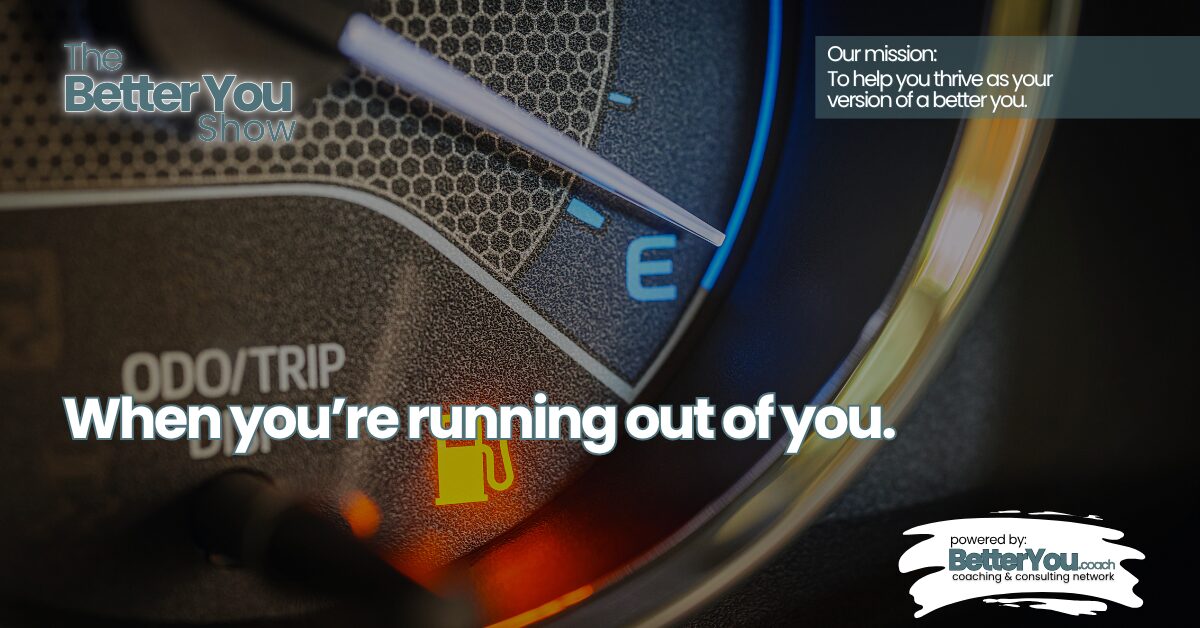
You’re not losing your patience because you’re careless. You’re losing your patience because you’ve run out of fuel.
Some Relief
Give your brain fewer decisions to make in the evening. This could look like:
- a simple dinner rotation
- a “default evening” routine (routine = pre-made decision)
- laying out clothes or lunches the night before
- planning for your week on your days off
Every decision you remove gives you a little more patience back.
Your Biology Is Working Against You by Late Afternoon
This part is often overlooked, but it’s one of the biggest reasons you crash at home.
By the end of the day, your body is usually:

- under hydrated
- under nourished
- overstimulated
- under rested
Your brain can’t regulate emotions well when your blood sugar is unstable or your hydration is low. Studies in nutritional neuroscience show that protein intake, hydration, and micronutrients play a significant role in mood stability and cognitive functioning.
Supporting your physiology throughout the day can make a world of difference here and give you a fighting chance. Some tips include:
- drink water before coffee
- eat a protein rich breakfast
- have a balanced afternoon snack
- get sunlight in the morning
- keep a water bottle with a straw near you during the day
These small shifts stabilize your mood so you don’t hit the evening wall as hard.
You’re Carrying the Mental Load Even When You’re Not at Home
You know that feeling of walking through the door and instantly switching into a different role? That’s the mental load.
It’s the invisible list you carry in your head:
- who needs what
- what needs to be done
- what you forgot
- what you’re behind on
- what tomorrow requires
Harvard research shows that women do the majority of cognitive labor in households, even in relationships that feel equal.
You’re Also Managing Everyone’s Emotions Without Realizing It
Sociologists call this emotional monitoring. It’s the constant scanning of the room to sense how everyone is feeling. It’s invisible work, but it drains your energy fast.
Sensory Overload Makes Small Things Feel Big
Homes are often louder, messier, and more stimulating than workplaces. When your nervous system is already tired, even normal household noise can feel like too much.
So when you get home, you’re not off. You’re switching from one demanding job to another.
No wonder you’re out of patience. You’re not resting. You’re running from one foxhole to another.
Lightening The Mental Load
A few things you can do to lighten the load so you don’t feel like you’re on the battlefield.
- writing things down instead of holding them in your head
- sharing responsibilities instead of silently carrying them
- creating “quiet minutes” when you first get home
Give your brain a moment to land.
You Don’t Have a Transition Ritual to Reset Your Nervous System
Most women go straight from work mode to home mode without any kind of reset. Your brain doesn’t get a chance to shift gears.
Research on stress recovery shows that even brief pauses can help your body shift out of a stress response. Getting your nervous system to move from stress activation into calm regulation.
Role Switching Has a Cognitive Cost
Research on task switching shows that every time you change roles, your brain pays a small tax. It’s like changing lanes on a busy highway. It takes effort and attention. And after driving a long way, all of that adds up and you’re exhausted even though you didn’t do any physical labor.
Your Window of Tolerance Shrinks by Evening
Dr. Dan Siegel describes the window of tolerance as the range where you can function well. Stress, depletion, and overstimulation shrink that window. By 5 PM, you’re often operating inside a very narrow space.
Without a reset, you walk into your home with the same tension you carried all day.
And your family gets the overflow.
Your Transition Ritual
Create a transition ritual that signals “I’m shifting roles now.” This could be:
- a short walk
- sitting in your car for two minutes
- changing clothes
- washing your face
- listening to a calming song
- breathwork
Your nervous system needs a cue that the day is changing.
You Feel Guilty Resting, So You Don’t Refill Your Tank
This is the part that hits hardest. Women tell me all the time:
“I feel guilty sitting down.”
“I feel guilty taking time for myself.”
“I feel guilty if I’m not doing something.”
The Myth of Infinite Capacity Keeps You Overextended
Women are socialized to believe they should be endlessly capable, endlessly giving, endlessly patient. This creates chronic overextension.
But here’s the truth:
You can’t pour into anyone if you’re running on fumes. And guilt doesn’t mean you’re doing something wrong. It means you’re doing something unfamiliar.
Guilt-Free Micro Rests
When you’re just starting out, relieving that guilt can be hard so finding something that gives you a feeling of rest but is still productive in the way you need it can bring relief. Some ideas might be:
- sit for two minutes
- breathe for one minute
- drink water before doing anything else
- step outside for fresh air
Small rests feel safer and help retrain your nervous system to accept care.
You’re Not Broken. You’re Depleted. And It’s Fixable.

This is the part I want you to hear clearly.
You’re not short tempered because you’re a bad mom or a bad partner or a bad person.
You’re short tempered because:
- your emotional reserves are gone
- your biology is under supported
- your mental load is heavy
- your transitions are missing
- your guilt is loud
- your identity patterns are outdated
The Rebound Effect Makes You Release Emotions at Home
Attachment research shows that people often release pent up emotions around the people they feel safest with. It’s not fair, but it’s human.
This, like a lot of the other pieces here, is all a pattern.
Pattern-Breaking
Once you understand the pattern, you can finally change it.
Not by trying harder. Not by pushing through. Not by being more disciplined.
By supporting yourself the way you support everyone else.
Try to name the pattern without shame or judgement. Something like, “I’m not angry. I’m depleted because…”
This simple reframe softens your internal dialogue and helps you respond instead of react.
If You Want Support Understanding Your Pattern
You don’t have to figure this out alone. If you’re reading this and thinking, “This is exactly me, but I don’t know where to start,” that’s usually the moment when having someone in your corner makes everything feel lighter and more doable.
A connection call is simply a conversation with our placement specialist who helps you understand where you are right now and what kind of support would actually fit your personality, your goals, and your real life.
It’s free. It’s not a commitment. It’s clarity.
Women often tell us that this call alone feels like the first deep breath they’ve taken in months.
If you want to stop coming home exhausted and out of patience and start feeling like yourself again, this is the easiest next step.
Start here: https://betteryou.coach/start
What This Means for You
You’re not losing your patience because you don’t care. You’re losing your patience because you’ve been carrying too much for too long without the support, nourishment, or space you need to stay regulated.
Once you understand the pattern, you can finally change it.
And you deserve that.
The Research Behind This Article
- Baumeister, R. F., & Muraven, M. (2000). Self Regulation and Depletion: The Strength Model of Self Control. Journal of Personality and Social Psychology. Explains how self control functions like a muscle that tires with use, which helps clarify why decision fatigue makes patience harder to access by evening.
- Gibson, E. L. (2006). Emotional Influences on Food Choice: Sensory, Physiological, and Psychological Pathways. Physiology & Behavior. Shows how hydration, protein intake, and micronutrients directly affect mood stability and emotional regulation, supporting the biology section of the article.
- Daminger, A. (2019). The Cognitive Dimension of Household Labor. American Sociological Review. Identifies the four components of cognitive labor and demonstrates that women disproportionately carry the mental load, even in seemingly equal partnerships.
- Porges, S. W. (2011). The Polyvagal Theory: Neurophysiological Foundations of Emotions, Attachment, Communication, and Self Regulation. W. W. Norton. Describes how the nervous system shifts between stress and calm states, supporting the need for transition rituals that help women downshift after work.
- Hochschild, A. R. (1983). The Managed Heart: Commercialization of Human Feeling. University of California Press. Introduces the concept of emotional labor and emotional monitoring, validating the invisible emotional work women perform at home.
- Mikulincer, M., & Shaver, P. R. (2016). Attachment in Adulthood: Structure, Dynamics, and Change. Guilford Press. Shows how people release pent up emotions in safe relationships, explaining why women often lose patience at home even when they held it together all day.
- Siegel, D. J. (2010). Mindsight: The New Science of Personal Transformation. Bantam Books. Provides the framework for the window of tolerance, helping women understand why their emotional bandwidth shrinks by evening.
- Rubinstein, J. S., Meyer, D. E., & Evans, J. E. (2001). Executive Control of Cognitive Processes in Task Switching. Journal of Experimental Psychology: Human Perception and Performance. Demonstrates that switching between tasks or roles carries a measurable cognitive cost, helping explain why transitioning from work to home feels mentally exhausting.
- Inzlicht, M., & Schmeichel, B. J. (2012). What Is Ego Depletion? Toward a Mechanistic Revision of the Resource Model of Self-Control. Perspectives on Psychological Science. Reexamines the concept of decision fatigue and suggests that shifts in motivation and attention, not just depleted resources, contribute to reduced self-control later in the day.
- Sonnentag, S., & Fritz, C. (2007). The Recovery Experience Questionnaire: Development and Validation of a Measure for Assessing Recuperation and Unwinding from Work. Journal of Occupational Health Psychology. Shows how intentional recovery activities help the nervous system downshift after work, supporting the idea of transition rituals.
- Mullainathan, S., & Shafir, E. (2013). Scarcity: Why Having Too Little Means So Much. Times Books. Explains how limited mental bandwidth reduces cognitive capacity and patience, reinforcing how overload contributes to irritability and reduced emotional regulation.
Disclaimer
BetterYou.coach is a coaching network that matches people with their next right coach. We believe you’re not broken, you’re just human. And sometimes humans need support to thrive.
The Better You Show and any content posted by BetterYou.coach, Doris Efford, and/or any agents of BetterYou.coach is presented solely for general informational, educational, and entertainment purposes. The use of information from the aforementioned sources or materials linked is at the user’s own risk and there is potential for monetary compensation at no extra cost to the user. It is not intended as a substitute for the advice of any professional and/or individualized advice. Users should not disregard or delay in obtaining professional advice for their individual condition or situation.
For personalized coaching, contact BetterYou.coach.
Leave a Reply